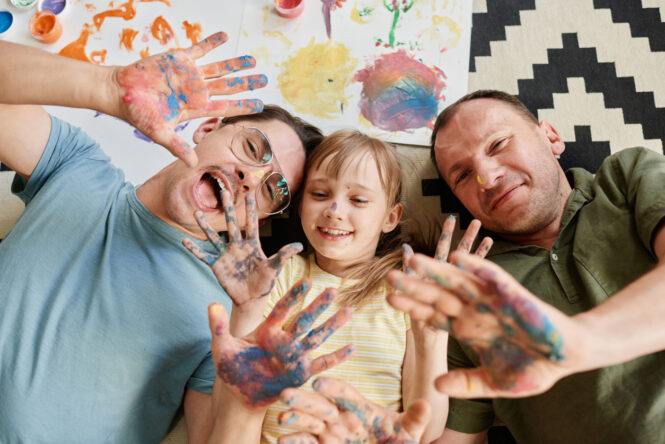
More LGBTQ+ couples in the UK and beyond are turning to adoption, not just as a way to grow their families, but as a deliberate, thoughtful path that reflects their values and realities. The process isn’t without its challenges, but it’s becoming increasingly common, supported by changing laws, social attitudes, and a wider understanding of what makes a good parent. Here’s why more LGBTQ+ couples are embracing adoption, and what the journey tends to look like in real life.
Biological barriers mean adoption feels like a natural route.
For many same-sex couples, having children biologically often requires medical intervention, surrogacy, or sperm/egg donors. Adoption, while still a long and sometimes emotional process, offers a direct way to become parents without the same physical and financial demands. It also gives couples the chance to provide a home to a child who genuinely needs one, which can feel like a deeper calling rather than just a plan B. For lots of queer couples, it’s a practical choice and a meaningful one.
Adoption allows both partners to have equal footing
In biological scenarios, especially in lesbian couples using donor sperm, one partner carries the baby, which can create an imbalance in the parenting experience. With adoption, both parents usually come into the child’s life at the same time, creating a more even dynamic. That shared beginning can help cement the sense of family early on. It can also feel more inclusive, especially for couples who want to move forward without one partner feeling sidelined or secondary.
Attitudes toward LGBTQ+ adopters are slowly improving.
While discrimination hasn’t vanished, agencies and adoption services in many parts of the UK have become more inclusive. LGBTQ+ couples are no longer automatically pushed to the bottom of the list, as they were in past decades. Some local authorities even actively encourage LGBTQ+ applicants, especially as the need for adoptive parents continues to grow. It’s still important to find an agency that genuinely respects diverse family structures, but progress is being made.

Queer couples often bring strong empathy to parenting.
Many LGBTQ+ people know what it’s like to feel “different,” to navigate rejection or misunderstanding. This lived experience can make them more empathetic and emotionally in tune as parents, particularly for children who’ve experienced loss or trauma. Adoption isn’t always smooth, and children in care often come with complex needs. Queer couples frequently bring a depth of patience and resilience that’s especially helpful in these situations.
Adoption offers a path through existing legal systems.
In the UK, adoption provides clear legal recognition of both parents—something that’s not always straightforward when donor sperm, surrogacy, or overseas birth certificates are involved. Having that legal clarity can offer peace of mind and eliminate future complications. It also sends a powerful message to the child: both parents are equally “official,” and the family unit is fully protected by law.
The adoption process is now explicitly open to LGBTQ+ applicants.
Since 2005, UK law has allowed unmarried and same-sex couples to adopt jointly. Before that, one partner had to adopt and the other could only apply for parental responsibility later, which created complications. Now, queer couples can adopt as a team from the very beginning, with equal legal rights and recognition. This change has made the adoption process feel less marginalising and more accessible.
Children in care are in desperate need of loving homes.
There are thousands of children in the UK waiting to be adopted, many of whom are older, part of sibling groups, or come from difficult backgrounds. These children often face the longest waits for placement. Some LGBTQ+ adopters specifically request to take in children who are harder to place, wanting to meet the need where it’s greatest. The desire to give a home to someone who might otherwise be overlooked is a strong motivator.

Social workers are getting better at supporting diverse families.
Historically, many LGBTQ+ adopters felt scrutinised or misunderstood by professionals involved in the process. But as training has improved and inclusivity has become a bigger focus, the experience is gradually becoming more supportive. Social workers today are more likely to be familiar with LGBTQ+ issues, biases, and dynamics. While it still varies from area to area, couples are finding the process more affirming than they might have a decade ago.
Adoption gives children a new story—not a replacement, but a future.
Lesbian, gay, and queer adopters often approach parenting with a deep awareness that love doesn’t always follow a traditional path. That mindset can be incredibly powerful when raising adopted children, who may feel rejected or “unwanted.” Rather than glossing over the child’s history, many LGBTQ+ parents embrace the idea of building a new story together—one rooted in choice, love, and acceptance. That foundation can help build real, lasting trust.
Visibility of LGBTQ+ families has made adoption feel more possible.
As more LGBTQ+ families share their stories, appear in media, and speak openly about their adoption journeys, others see what’s possible. That visibility matters—it makes adoption feel less intimidating or out of reach. Knowing that there’s a community of other LGBTQ+ parents out there can make the journey less isolating, especially during the more emotional parts of the process.
Adoption can feel deeply affirming for couples who’ve faced rejection.
Some LGBTQ+ couples come to adoption after years of being told they “shouldn’t” or “couldn’t” have children. Choosing to adopt and being approved can be incredibly healing after past experiences of exclusion. It becomes more than just a way to become parents—it’s a way to reclaim the idea of family on their own terms. That sense of agency can mean a lot, especially for those who’ve had to fight to be seen.

Many LGBTQ+ adopters become role models without even trying.
Children in care come from a range of backgrounds, and seeing LGBTQ+ parents live openly and lovingly can have a huge impact—not just on the child, but on their wider community. Representation matters. Being part of a visible, loving LGBTQ+ family can help break down stigma and normalise diverse family structures for the next generation.
The process still has red tape, but it’s increasingly navigable.
Adoption involves home assessments, background checks, training sessions, and a lot of paperwork. That hasn’t changed. But for same-sex and queer couples, the process is no longer filled with extra hurdles or quiet prejudice in the same way it once was. Yes, it’s still intense, but it’s not insurmountable—and the fact that more and more LGBTQ+ couples are navigating it successfully proves that the barriers are finally breaking down.
It’s a way to create the family life they never thought they’d have.
For many LGBTQ+ people, especially those who grew up in less accepting times or communities, the idea of having a family once felt impossible. Adoption is helping rewrite that narrative. It’s a chance to give love, stability, and guidance to a child who needs it—and to build a life that might once have seemed completely out of reach. It’s not always easy, but it’s deeply worth it.