Coming home to find somebody parked across your driveway is one of those things that can ruin your mood almost instantly.

Sometimes it’s someone visiting a neighbour for ten minutes. Other times, it’s a complete stranger who has decided your driveway somehow looks like public parking. The frustrating part is that a lot of people assume the law is much clearer than it actually is. In reality, UK driveway parking rules sit in a strange grey area where what feels obviously wrong is not always treated as a criminal offence, and that catches a lot of homeowners off guard.
Blocking your driveway and parking on your driveway are treated differently.
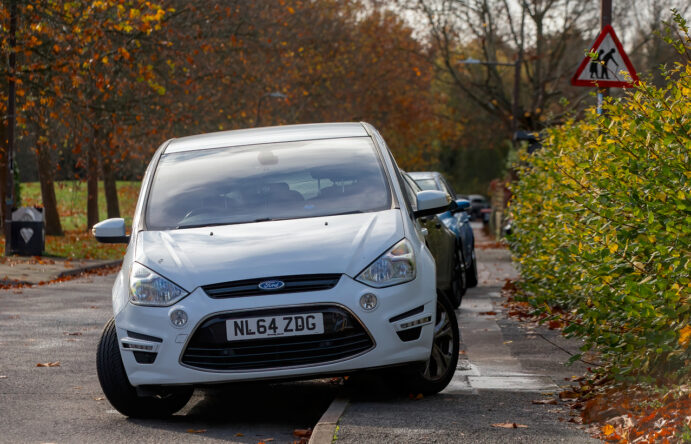
One of the biggest misunderstandings is that these situations are legally identical, but they’re not. If somebody parks directly on your private driveway without permission, it’s usually treated as trespassing. But in the UK, trespassing is normally considered a civil matter rather than a criminal one. In other words, police generally won’t turn up and remove the car for you.
Blocking access to your driveway from the road is slightly different. In some situations, councils or police may get involved if the obstruction affects access to the highway, especially where dropped kerbs are involved.
The law becomes more serious if somebody blocks your car in.

This is where the rules start changing more noticeably. If somebody parks across your driveway, but you can still get your own vehicle out, police often treat it as a parking or civil issue. That being said, if their vehicle physically traps your car on your driveway and prevents you leaving, it may become an antisocial behaviour or obstruction issue.
That doesn’t always mean immediate towing or dramatic action, obviously, but it does move the situation beyond a simple neighbour dispute.
Dropped kerbs matter far more than many people realise.

A lot of enforcement around blocked driveways actually revolves around dropped kerbs rather than the driveway itself. Under civil parking enforcement rules, parking across a dropped kerb can lead to penalties in many council areas. Some councils can issue fines or enforcement notices even if the vehicle is only partly obstructing access.
This is partly because dropped kerbs are also considered important for pedestrians, wheelchair users, and pushchairs, not just homeowners accessing driveways.
The Highway Code does advise drivers not to block entrances.

Rule 243 of the Highway Code specifically advises drivers not to stop or park in front of property entrances, but this is where people often get confused. Some Highway Code rules use the phrase “must not,” which makes them legally enforceable. Others simply say “do not,” which acts more as guidance than a direct criminal offence.
In other words, somebody blocking your driveway may still technically be acting against the Highway Code without automatically committing an offence police will immediately enforce.
You’re not legally entitled to the road space outside your house.

This one annoys a lot of people, but in most UK streets, the road outside your home is public parking unless restrictions apply. Basically, neighbours, visitors, or strangers can legally park outside your house provided they’re not causing obstruction or breaking parking restrictions. People often treat the space outside their property like an unofficial extension of their driveway, but legally, that’s usually not how it works.
You shouldn’t clamp, damage, or trap somebody’s vehicle.

A lot of homeowners understandably fantasise about blocking the offending car in, letting tyres down, or using wheel clamps. Legally, though, that can backfire badly. In England and Wales, private wheel clamping without lawful authority became illegal under the Protection of Freedoms Act 2012. Damaging the vehicle or deliberately preventing the owner from retrieving it could also potentially become a criminal matter.
Even though somebody parking on your driveway feels deeply unfair, taking aggressive action yourself can sometimes leave you in more legal trouble than the person who parked there.
Your first step is usually the boring one nobody wants to hear.

Most official advice still recommends trying to locate the owner calmly first. That’s frustrating when emotions are already high, especially if you’re late for work or unable to leave your driveway. But many driveway disputes do genuinely start from thoughtlessness rather than deliberate malice. Neighbours may know who the car belongs to, or the driver may simply not realise they’re causing a problem.
Local councils sometimes have more power than people realise.

Depending on where you live, councils may enforce dropped kerb obstruction rules under Civil Parking Enforcement schemes. That means civil enforcement officers can sometimes issue penalty notices without police involvement. But enforcement varies heavily between councils, which is why people often hear completely different advice depending on their area.
Some councils respond quickly to blocked dropped kerbs. Others may treat it as low priority unless access is completely obstructed.
You may have stronger options if the problem becomes persistent.

A one-off parking issue is annoying enough. Repeated blocking or trespassing is where people often start looking at preventative measures instead. Retractable bollards, lockable posts, CCTV, clearer driveway markings, and legal notices are all increasingly common, especially in busy residential areas near stations, schools, stadiums, or shopping centres.
Some homeowners also pursue civil action in ongoing disputes, particularly where access rights or shared driveways are repeatedly obstructed.
The biggest surprise for most people is how limited the immediate legal powers actually are.

People often assume somebody blocking or parking on a driveway automatically means police can remove the vehicle straight away. In reality, the law is much slower, narrower, and more situation-dependent than most people expect. And honestly, that’s why so many driveway disputes in the UK end up becoming awkward neighbour stand-offs rather than quick legal fixes.