The little Wi-Fi router blinking quietly in the corner of your living room might be doing more than you think.
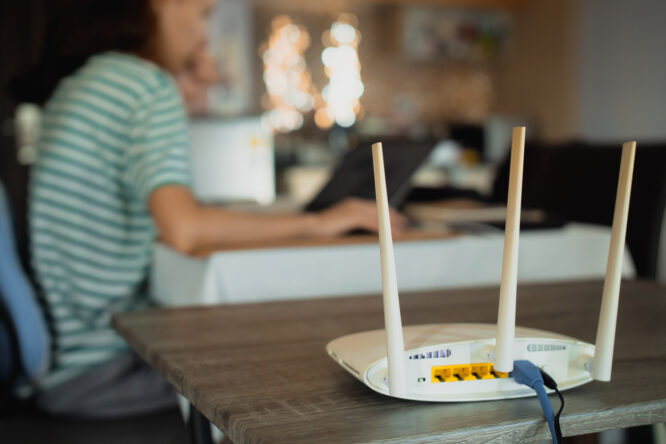
A team of scientists has just shown that ordinary household Wi-Fi can be used to identify and track people with near-perfect accuracy, even when they’re not carrying a phone, wearing a smartwatch, or interacting with any technology at all. The findings are pretty unsettling, and they raise serious questions about privacy in a world where wireless signals are absolutely everywhere. Here’s what the research actually showed, and what it means for the rest of us.
The experiment was pretty in-depth.

Researchers in Germany built a system that uses standard Wi-Fi signals to detect, watch, and recognise people simply by analysing how radio waves bounce off their bodies. The same way light bounces off you when you walk in front of a camera, radio waves do the same thing as they spread through a room. By picking up those tiny patterns and changes, the system can effectively create a picture of who’s there and how they move.
What makes the discovery genuinely alarming is that it doesn’t need any special kit. Earlier experiments along these lines required expensive sensors and specialised equipment, but this new system works with the kind of cheap, standard Wi-Fi router most homes, cafes, and offices already have. That means the building blocks for the technology are already installed in almost every public and private space across the country.
How accurate is it?

In tests involving nearly 200 different people, the system identified individuals with close to 100 per cent accuracy. The recognition worked regardless of how the people were standing, which way they were walking, or what angle they happened to be approaching the router from. Once the system had been trained on the patterns of a particular person, picking them out again later took just a few seconds.
The science behind it is pretty clever. Every human body interferes with radio waves in slightly different ways, based on shape, height, posture, and even how someone walks. Those tiny, unique patterns act a bit like a fingerprint, only one made of disturbances in invisible radio signals rather than ink on paper. Once you know what to look for, you can spot the same person again days, weeks, or months later.
Your phone being off doesn’t help.

You might assume the easy way to dodge this kind of surveillance is to switch off your phone or leave it at home. According to the researchers, that wouldn’t actually work. The system relies on radio waves bouncing off your body, not on signals from any device you might be carrying. So whether your phone is on, off, or sitting on a charger fifty miles away, you can still be picked up.
The only things that need to be active are other nearby wireless devices on the network, like a smart speaker, a laptop, or someone else’s phone. Since those things are almost always switched on in any public or private space these days, the system has plenty of signal activity to feed on. The result is that just walking into a room could be enough to give away who you are.
This could hold significance in everyday life.

Imagine walking past your local café once or twice a week. The Wi-Fi network in there could, in theory, learn to recognise you. Walk into the same café a month later and the system would know exactly who you are, even if you’ve never connected to the network and never given them any information about yourself. Walk into a shop with the same technology elsewhere, and they could potentially link up the data.
That has big implications for everyday privacy. Companies could quietly track customer visits without anyone realising it. Public buildings could log who’s coming and going without cameras. Authorities could monitor people in protests, political gatherings or anywhere else where being identified would be a real concern. The system is so invisible that nobody would have any idea it was happening.
Why is this different to existing surveillance?

Surveillance technology already exists in plenty of forms, including CCTV, facial recognition cameras, mobile phone tracking and connected doorbells. What makes this new method different is the sheer scale of where it could operate. Wi-Fi is everywhere, in homes, offices, restaurants, train stations, airports, libraries, gyms, shopping centres and on public transport. There’s almost no public space left without some kind of wireless network running in the background.
Cameras can be spotted, covered or avoided. Wireless signals can’t. They pass through walls, around corners and into spaces where you’d never normally expect to be watched. That combination of being invisible, widespread, and not requiring any device on your person is what makes the technology so concerning. Even the researchers behind it have called for stronger privacy protections to be written into future Wi-Fi standards.
There’s a data leak that makes it possible.

The technical reason this all works comes down to a small bit of data that Wi-Fi devices and routers exchange constantly, called beamforming feedback information. It’s a sort of digital chatter that helps networks adjust signal strength to keep your connection running smoothly. The trouble is that this information is sent without being encrypted, which means anyone within signal range can potentially pick it up and analyse it.
That open door is what allows the system to function with such precision. Multiple Wi-Fi signals bouncing around a room give the system several different “views” of a person, which is how it can build such a detailed picture. Once an AI model has been trained on those signal patterns, identifying someone becomes as quick as recognising a familiar face in a crowd. Without proper encryption of that feedback data, the same trick could be performed by anyone with the right software.
Experts are calling for clarity and reassurance.

The team behind the research are clear that they’re not building this technology to harm people. They’ve published their findings specifically to draw attention to the privacy risks, in the hope that protections can be built into future Wi-Fi standards before the technology spreads further. Their main recommendation is that the next generation of wireless standards should encrypt the kind of feedback data that makes this surveillance possible.
There’s also a wider conversation needed about how this kind of capability should be regulated. In countries with strong democratic protections, the law might catch up. In authoritarian states, the technology could be used to monitor political opponents, journalists, and protesters without anyone knowing they’re being watched. The researchers have flagged this as a particularly worrying use case, and they’re urging policymakers to take it seriously.
Can you actually do anything about it?

Honestly, not a huge amount yet, since the technology isn’t widely deployed at the moment. The bigger battle will be fought by lawmakers, privacy advocates and the people who write the next set of Wi-Fi standards. As an individual, the most useful step is to stay aware of what’s possible, which makes you a better-informed voice when these decisions get made.
For now, you can take general privacy precautions like keeping your home network secure, using a strong router password, and being mindful of how connected your home is becoming. Smart speakers, smart doorbells, smart fridges and a load of other devices all add more wireless activity for any future system to potentially pick up. Being thoughtful about which gadgets you really need is a small but meaningful way to limit your own digital footprint.