
There are people who swear blind they can untether their awareness from their physical self entirely, floating up to the ceiling and looking down at their own motionless body like an outside observer.

It sounds like pure Hollywood fiction or late-night sci-fi, the sort of supernatural yarn you’d laugh off around a campfire without giving it a second thought. However, neuroscientists haven’t just dismissed the phenomenon as pure fantasy. Instead, they’ve hooked volunteers up to clinical equipment, set up controlled experiments, and tried to test whether an out-of-body experience is something you can measure in a laboratory. Setting out to debunk a spooky myth is one thing, but what the team stumbled across once the trial was underway turned out to be far stranger and more puzzling than anyone in the room anticipated.
What does an out-of-body experience entail?
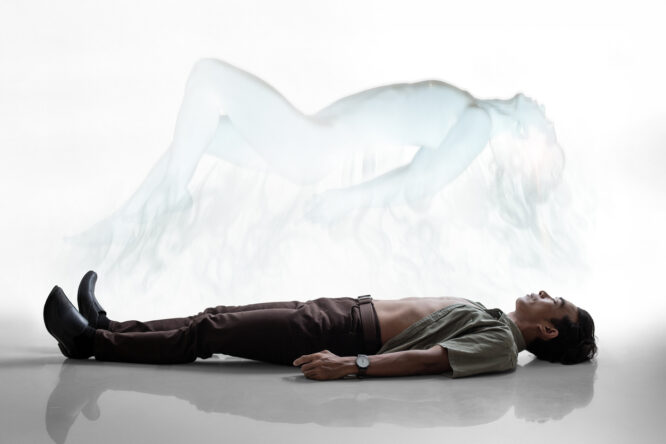
An out-of-body experience is when someone feels like their awareness has separated from their physical body, letting them observe things from a completely different spot in the room, or even a different room entirely. People have described this feeling for centuries, but nobody’s ever managed to properly prove it happens in a way science can measure.
The obvious question is how someone could see anything at all if their actual eyes are lying closed somewhere else. It’s a question researchers have been trying to test properly for decades, usually by hiding something from a person’s normal senses and asking them to describe it afterwards.
How was this new experiment set up?

A team led by a neuroscientist at the University of Virginia designed a fresh version of this test, working with 21 people who all claimed experience with out-of-body experiences. The setup used three separate rooms to make sure nothing could be seen or overheard by accident.
The first room held the participant, hooked up to equipment that tracked their brain activity while they tried to have the experience in comfortable surroundings. The second room held the researchers themselves, with the door shut throughout. The third room contained the actual target, a laptop showing a randomly picked image from a pool of one hundred possible options, with the screen deliberately turned to face the wall.
The researchers went to great lengths to rule out cheating.

To make sure nobody could accidentally influence the results, not even the researchers knew which image had been chosen until months later, once all the results had been collected. One researcher would set the random selection running, turn the screen away, and then leave the room entirely before the image even appeared.
Each participant then had between one and one and a half hours to try to perceive what was on that screen, sitting a fair distance away down a hallway with a closed door in between. It’s about as careful a setup as you could design for this kind of test, removing almost any realistic way someone could have picked up a clue through normal means.
What did most of the participants experience?

Out of the 21 people who took part, 13 came away with some kind of impression they believed related to the hidden image. Of those, only 8 described it as a genuine out-of-body experience, while the other 5 said they’d picked up impressions through something more like an inner mental image rather than feeling like they’d left their body.
Each participant described what they’d sensed in as much detail as they could, the same way you might describe an apple as red and round if that’s what came to mind. Researchers then used artificial intelligence to compare each description against all one hundred possible images, ranking how closely each one matched what was shown on the screen.
The results showed some surprising results about the hidden image.

If someone had truly seen the correct image, you’d expect it to rank near the top of that comparison list. Instead, the actual target images ranked anywhere from 16th all the way down to 92nd out of the hundred possibilities, which is basically no better than random guessing.
As a check on the AI system itself, researchers also fed it accurate, detailed descriptions of the images to make sure it could correctly match them when given the real thing. It had no trouble at all in that case, which confirms the poor results weren’t down to a flaw in how the comparisons were made. In short, nobody in the study managed to correctly identify the hidden image.
The strange twist that came from a completely different room.

Even though the main experiment came up empty, something odd happened involving the second room, the one where the researchers themselves were sitting rather than the room containing the hidden image. Two participants ended up describing details about that room that nobody had asked them to focus on at all.
One participant described one researcher sitting to the left focused on a screen, while the other sat further back in the corner reading a book, an arrangement that hadn’t happened in any other session. Checking back, that was exactly how the room had been set up during that particular attempt. A second participant separately described a different but equally specific arrangement, again matching exactly what had truly been happening in the room at the time.
This doesn’t count as proof, even though it’s odd.
As striking as these two cases sound, the researchers are quick to point out they don’t count as solid evidence. Neither observation was part of the planned experiment, meaning they weren’t tracked or analysed with the same rigour as the actual target task, so they’re best described as interesting anecdotes rather than proof of anything.
Similar stories have popped up before in out-of-body research, including a case from the 1960s involving a well-known practitioner who failed to identify a hidden target but accurately described a stranger who’d turned up unexpectedly outside the experiment room. Even then, the original researcher involved noted there could have been a much simpler explanation, such as overhearing a conversation during a break.
This could have meaning for future research into the topic.
The researchers behind this new study think part of the problem might come down to what’s being used as a target in these experiments. A static image or a simple list of numbers might just not be interesting or attention-grabbing enough to actually show up clearly during whatever it is people experience during these episodes.
Rather than closing the door on the topic, the team hopes these unexpected findings encourage other scientists to think more creatively about how experiments like this are designed in future. As one of the researchers put it, the bigger question isn’t just whether these experiences are real, but what we even mean by real in the first place, and whether our current understanding of the mind is broad enough to explain everything people report experiencing.
If nothing else, this study is a reminder that even carefully designed science doesn’t always produce a neat, tidy answer, and sometimes the most interesting part of an experiment is the bit nobody was looking for.