If you’ve ever spent the night staring at the ceiling and trying every breathing trick in the book, the idea of sitting up and making buzzing noises might sound like you’ve finally cracked.

But there’s actually a bit of proper science behind why “bee breathing,” or Bhramari Pranayama if you want the formal name, is more than just a bit of New Age fluff. Researchers have been looking into how these specific vibrations act like a manual override for your nervous system, physically forcing your body to pack in the “fight or flight” stress and actually start relaxing.
It’s more than just the distraction of the noise at play; it’s about how that low-frequency humming sends a signal straight to your brain that it’s safe to pipe down for the night. While it might feel a bit daft the first time you try it in a dark room, the impact it has on your heart rate and your stress levels is very real, and it could be the simplest way to finally get some decent shut-eye without reaching for the herbal tea.
What is the bee hum method?

It goes by a few names: bumblebee breathing, bhramari pranayama, bee breath. It comes from yoga and has been practised for centuries, but it’s been picking up attention lately as a legitimate sleep aid rather than something only useful in a 6am yoga class. The method involves covering your ears with your thumbs, placing your fingers gently over your closed eyes, breathing in deeply through your nose, and then exhaling with a low humming sound while keeping your lips closed. You repeat that up to 10 times, and that’s it.
Why would humming help you sleep?

The short version is that it works on your nervous system. The longer version is that the vibration and the controlled exhale activate your parasympathetic nervous system, which is the part responsible for bringing your body down from a state of alertness. When you’re lying awake at 3 a.m. with your brain fully switched on, your sympathetic nervous system is running the show. The bee hum method is basically a way of manually overriding that.
The humming specifically seems to extend the exhale, and longer exhales are consistently linked to lower heart rate and reduced anxiety. There’s also something about the physical sensation of the vibration that seems to quiet mental noise in a way that plain deep breathing doesn’t always manage.
What does the research say?
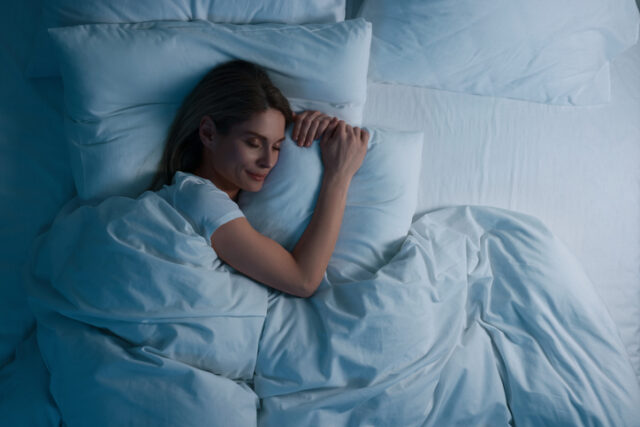
A 2025 paper in the International Journal of Ayurveda360 looked at bumblebee breathing and found it helped with sleep initiation, sleep continuity, and sleep depth—yes, all three. Sleep continuity is the one most people with maintenance insomnia care about most. After all, waking at 3 a.m. and lying there for an hour is a different problem from struggling to fall asleep in the first place, and a lot of sleep advice is aimed at the latter rather than the former.
The findings also suggested it may reduce the impact of disturbances, which matters if you share a bed or live somewhere noisy. The other thing worth knowing is that it costs nothing and has no side effects, which puts it ahead of plenty of other things people try.
How do you actually do it?

The steps are straightforward. Lie down or sit up, whichever feels more natural. Cover your ears with your thumbs, so outside sound is muffled. Rest your first three fingers lightly over your closed eyes. Take a slow, deep breath in through your nose. As you exhale, make a continuous humming sound, keeping your mouth closed and your lips gently together.
The hum should feel like it’s vibrating slightly in your face and chest. Then breathe in again and repeat. Most guidance suggests anywhere between five and ten repetitions, so you’re looking at roughly two to three minutes total. It feels odd the first time. You might feel a bit self-conscious, even alone. However, most people find it becomes quite natural by the second or third breath.
Is it just another breathing technique?

There are plenty of breathing methods out there already. The 4-7-8 method is probably the most well-known, and box breathing gets recommended a lot for anxiety. Finger breathing is one that gets used with children. What sets bee hum apart from most of those is the humming component. The vibration adds something that a plain breathing pattern doesn’t have. It gives your attention somewhere to land, which is useful when your mind is busy, and the physical sensation keeps you anchored in a way that pure breath focus sometimes doesn’t.
It also requires a little more active participation than lying still and counting, which seems counterintuitive but actually helps some people. If your brain needs something to do to stop spiralling, the hum gives it a job.
Who is it most useful for?

Anyone dealing with sleep maintenance insomnia is the obvious answer. If you fall asleep fine but wake in the night and struggle to get back off, this is worth trying. It’s also a good fit if you wake feeling anxious or with your thoughts already running because the technique addresses the nervous system activation that tends to come with that kind of waking.
It’s gentler than some other methods and doesn’t require any equipment, apps, or prep. You can do it in the dark without disturbing a partner significantly, though they might notice. It’s less about inducing sleep from scratch and more about calming a system that’s switched on when it shouldn’t be. That distinction matters.
Are there any downsides?

Nothing serious, really. It can feel strange at first, and if you’re congested it’s harder to do properly because the nasal inhale is part of what makes it work. Some people find the ear-covering claustrophobic, though you can ease off on the pressure if needed. It’s also worth keeping expectations realistic. One night won’t fix long-standing insomnia, and it works best as a consistent practice rather than a last resort at 4am when you’re already frustrated.
Should you try it?

If you’re struggling with broken sleep, and you’ve already looked at the basics like screen time, room temperature, and caffeine, then yes, this is a reasonable next step. It takes under five minutes, it’s free, and the evidence behind it is more substantial than a lot of things that get recommended for sleep. The fact that it comes from a yoga tradition that’s been around for a very long time suggests it’s not just a wellness trend, either. People have been doing this for a reason.
It won’t work for everyone, but then nothing does. That being said, given what it asks of you in terms of effort and cost, it’s hard to think of a reason not to give it a go.