It always seems to happen when you’re least expecting it—you’re in the middle of something, and knock knock—there they are.
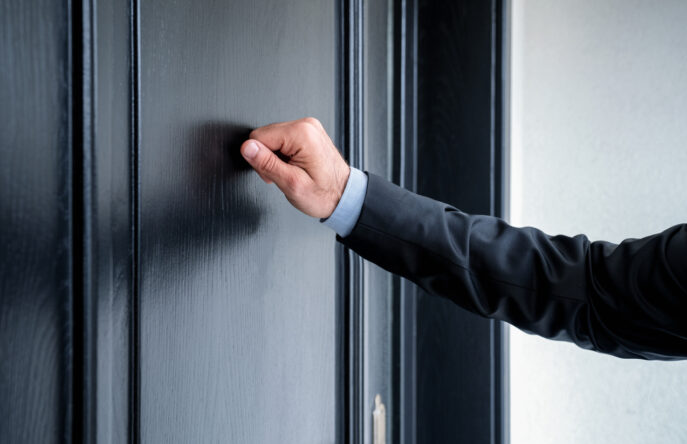
You open it up expecting a parcel delivery, only to be greeted by two sharply dressed strangers holding printed literature, ready to launch into a polished doorstep sermon. While most people admire conviction, an uninvited ideological pitch on your own threshold is rarely welcome.
The old advice from internet forums—pretending you don’t speak English, putting on an amateur dramatics display, or answering the door in a state of undress—is wildly outdated, awkward in practice, and completely unnecessary. You don’t need a pantomime act to protect your Saturday afternoon; you just need clear, realistic boundary management. Here’s how to wrap up the conversation quickly and civilly.
Be the calm, unyielding broken record.

The most effective tool on your doorstep doesn’t require a creative excuse or an argument; it relies entirely on repetitive brevity. A pleasant, steady, “No thank you, I’m not interested, have a good day,” sets a firm boundary without handing them any conversational fuel.
Canvassers are trained specifically to spot “hooks”—hesitations, polite questions, or half-hearted excuses like “I’m a bit busy right now,” which they view as an invitation to return next week. The moment you give a reason, you invite an objection-handling script. If they push past your initial decline with a rehearsed rebuttal, you do not debate the point. You simply repeat the same sentence at the same volume: “No thank you, we’re not interested.” Deliver it with a neutral smile, take half a step back, and close the door smoothly. You’re not being rude; you’re simply closing an unsolicited transaction.
Use your video doorbell as a digital filter.

In an era where smart doorbells and security cameras are on practically every porch, answering the physical door to an unidentified caller is optional. Screening your visitors digitally removes the social pressure of face-to-face interaction entirely. When you see two people holding clipboards or leaflets through the camera feed, you can either ignore the chime entirely or tap the microphone button on your phone.
A quick, crackly “Hello, can’t come to the door, not interested thanks,” delivered through the speaker takes five seconds and leaves zero room for debate. It creates an instant physical buffer that spares you the awkward doorstep dance while letting them know nobody is coming down the hallway.
Asked to be added to their “do not call” list.

Most people assume door-to-door religious groups wander around at random, but denominations like Jehovah’s Witnesses and the Latter-day Saints operate on meticulously organised territory maps. If you want a permanent solution rather than a temporary fix, use their own administrative system. Say calmly: “Please put this address on your Do Not Call list.”
Every congregation maintains a record of households that have formally requested no visits, and canvassers are strictly instructed to respect those notations during future territory sweeps. It shows you know how their organisation works, avoids an ideological debate, and saves you having the same conversation with a different pair six months down the road.
State your beliefs without debating theology.

One of the quickest ways to wind up trapped on your doorstep for twenty minutes is taking the bait when they ask an open-ended question about morality, world events, or faith. Trying to out-argue someone on scripture on your own doorstep is a fool’s errand.
Instead of debating, state an immovable position: “I’m entirely content with my current beliefs, thank you, and I don’t discuss personal faith on the doorstep.” It doesn’t matter whether you’re a devout Anglican, a practising Buddhist, or an atheist who hasn’t stepped inside a church in fifteen years. Claiming quiet, settled contentment removes their primary leverage point: the assumption that you are spiritually seeking or open to persuasion. When there’s no crack in the door to work with, they will naturally pack up their pamphlets and move along.
Set a physical boundary with a sign.

If you work from home, have a sleeping toddler, or have a dog that launches into a barking frenzy every time the letterbox rattles, waiting for the knock to happen is already a loss. A discreet, professional metal plaque or sticker beside the bell reading “No Unsolicited Callers, Sales, or Religious Groups” carries real weight.
In the UK, trading standards and local councils actively encourage “No Cold Calling” zones and door notices. Reputable organisations instruct their members to bypass houses displaying clear signage to avoid generating official complaints or hostility. It resolves the problem before someone even lifts their hand to your knocker, keeping your weekend completely quiet.
Call an immediate time out.

If you do open the door because you were expecting a courier or a neighbour, don’t let them launch into a broad rhetorical preamble. Take control of the exchange in the first five seconds. The moment they introduce themselves, cut in kindly but firmly: “I’m stepping out of the house in two minutes, so I don’t have time to stop, but thank you.”
Don’t elaborate, don’t invent a wild story about a boiling pan, and don’t apologise. It establishes an immediate, practical ceiling on the interaction. If they attempt to hand you a leaflet to read later, simply decline with a polite “No thank you, I won’t read it, so it’s best you keep it for someone else,” and shut the door.
Refuse the printed literature.

When a visitor realises you’re not going to stand on the porch and debate the state of the world, their automatic fallback is to try to leave you with something to read: a magazine, a glossy pamphlet, or a tract with a website link.
The common, polite British instinct is to take the paper just to make them go away, but accepting literature is actually counterproductive. In door-to-door methodology, taking a booklet registers as a successful interaction and flags your address as someone who was receptive. It practically guarantees a follow-up visit a fortnight later to “see what you thought.” Politely wave your hand and say, “No thank you, I won’t read it, so please save it for someone who will.” Declining the reading material cuts off the paper trail and signals a definitive end to the contact.
Tell them you’re busy working from home.

With millions of people now working remotely, your home isn’t just a weekend sanctuary; during the week, it’s an operational workplace. That reality provides an airtight, completely understandable boundary that even the most persistent canvasser understands.
If you answer the door wearing a headset or simply say, “I’m in the middle of a live client call, so I cannot talk,” there is literally no conversational countermove they can make. Nobody, regardless of how devout their mission is, wants to be responsible for derailing someone’s employment. Deliver the line without irritation, keep one hand on the door handle, and offer a quick nod before pulling the door to. It takes five seconds, explains your brisk manner, and shuts down the pitch instantly.
Blame your landlord.

If you live in a modern apartment block, a converted period property, or a gated development, cold-callers shouldn’t actually be roaming the internal hallways or buzzing individual flats at random. When someone rings the intercom or knocks on your flat door, you don’t need to debate their literature; you can simply invoke the building rules.
A straightforward “Cold-calling and canvassing aren’t permitted in this building, so you need to speak to building management,” moves the issue away from personal hostility and anchors it in property policy. It reminds them that they are trespassing in a private residential space, which usually prompts a quick apology and a brisk retreat towards the main exit.
Keep your door position defensive.

How you hold yourself in the doorway sets the entire power dynamic of the encounter. Swinging the front door wide open and stepping forward signals availability, essentially inviting the caller to unpack their speech and settle in for a long chat.
Instead, keep the door resting on a short arc—open it just enough to see who is standing there, keeping your hand resting firmly on the handle and your shoulder blocking the gap. This physical posture communicates that this is a brief, momentary pause rather than an open reception. When it’s time to end the exchange, you don’t have to make a theatrical movement; you simply complete the motion of closing the door as you deliver your final polite sentence.
Don’t apologise for setting a boundary.

The standard British default is to open every boundary with an apology: “I’m so sorry, but…”, “Really sorry to interrupt…”, “Sorry, not today.” While it feels polite, repeatedly apologising projects guilt and indecision, which experienced canvassers subconsciously interpret as social awkwardness they can gently push past.
You do not owe an apology to two unannounced strangers who interrupted your morning on your own private property. Dropping the “sorry” doesn’t make you aggressive; it makes you clear. Changing your phrasing from “Sorry, I can’t really talk” to a crisp, pleasant “Not today, thank you” strips away the hesitation. Clear, courteous boundaries are far more respectful to both parties’ time than five minutes of timid, apologetic dithering.
Remember you don’t owe anyone an answer.

Perhaps the most liberating realisation for any homeowner or tenant is that the front door knocker is an invitation, not a legal summons. There is no social contract that mandates you must drop what you’re doing, walk down the hall, and engage with whoever happens to be standing on the other side of the wood.
If you aren’t expecting a delivery and you don’t recognise the figures standing on the drive, simply letting the knock go unanswered is completely valid. Carry on buttering your toast, reading your book, or finishing your email. If they happen to catch a glimpse of you through the front window, you still don’t need to panic or hide behind the sofa; a simple, polite shake of the head and a wave of the hand from across the room tells them everything they need to know without you ever having to turn the key.