Whether you grew up in a terraced house in Manchester or a semi in Surrey, there’s this universal set of phrases that every British parent seems to inherit the moment they bring a child home from the hospital.

It’s an unwritten script passed down through generations, covering everything from the precise cost of leaving a light on in an empty room to the existential mystery of what your last servant died of. These aren’t just sentences; they’re the pillars of a very specific kind of domestic authority that relies on a mix of sarcasm, feigned exhaustion, and the absolute refusal to buy that at the cinema”when there are perfectly good sweets in the cupboard.
If you’ve ever been told that you’ll feel the benefit of taking your coat off indoors or been warned that if you keep pulling that face the wind will change, you’ve lived through the universal experience of the UK parenting handbook. These are some of the classic lines we all swore we’d never repeat—until we became the ones saying them.
Why every British parent ends up sounding the same

It’s one of life’s funny little mysteries. You promise yourself you’ll never sound like your mum or dad, then you have a kid and within a year, you’re saying things you swore you’d never say, in the exact tone they used. The script gets passed down silently, generation to generation, and most of it comes from the same well of British humour, anxiety, and barely disguised tiredness.
The funniest thing is how universal it is. A dad in Cornwall and a mam in Newcastle have never met, but their kids have heard the same lines, in roughly the same order, with roughly the same look on their faces.
“Because I said so, that’s why!”

This is the original closer, and the line every British parent reaches for when they’ve run out of patience and the child has asked “but why?” for the seventeenth time in two minutes. Nobody is satisfied with this answer, including the parent saying it, but it ends the conversation, which is the whole point.
Some parents try to fight it for a while, explaining their reasoning, justifying their decisions like it’s a court case, but eventually every single one of them caves and reaches for the line. It’s the verbal equivalent of switching off the Wi-Fi.
“I’m not made of money.”

This one usually gets pulled out in a shop, somewhere near the till, after a child has spent twenty minutes trying to add a Kinder Egg, a magazine, and something on the gondola end to the trolley. There’s no good response to it as a child. Saying nothing feels rude. Asking for the thing again feels reckless, and pointing out that mum or dad has just put a bottle of wine in the trolley feels like a recipe for disaster. This line is a closing argument that the child instinctively knows not to challenge.
“Shut that door, were you born in a barn?”

Always shouted from the kitchen, always with a hint of theatrical exasperation, and always at the exact moment you’ve come in from the garden in a hurry. The barn bit is the key because it implies a level of feral chaos that no British child is willing to be accused of. The variations include “were you brought up in a tent?” and “were you raised by wolves?” They all do the same job, which is to make you turn around and shut the door without arguing about it.
“If you fall and break your leg, don’t come running to me.”

This one’s pure logic-defying poetry. The whole sentence collapses if you think about it for more than two seconds, but no British parent has ever been challenged on it because the kid is usually too busy doing the dangerous thing in question. Variations include “you’ll have someone’s eye out with that,” and the deeply specific “if the wind changes, your face will stay like that,” which has terrified British children into mild compliance for at least four generations.
“It’s like Blackpool illuminations in here.”

The light-switch line. Said specifically, exclusively, by dads, with great regional pride. You’ll come downstairs in the morning and every light in the house is on because someone forgot to flick the switch on their way out of a room, and your dad will say it with a kind of weary pleasure, like he’s been waiting all morning for the chance.
Variations include “this isn’t Battersea Power Station” and “do you think electricity grows on trees?” all of which mean the same thing, which is that he’s just opened the gas bill.
“Put a jumper on, will you?”

Mum-coded, this one. The British parent’s first response to literally any complaint about temperature, mood, or general state of being. Cold? Put a jumper on. Bit sad? Put a jumper on. Got a cold? Put a jumper on. The heating is never going on, no matter what.
The thermostat is at 18 degrees, and it will stay at 18 degrees until October, and even then, there will be a long discussion before any radiator is allowed to so much as warm up. The jumper is the answer to almost every domestic problem in a British household.
“Five more minutes.”

The mum classic. It can mean five actual minutes if she’s in a good mood, or it can mean an hour, depending entirely on what she’s doing and how irritating you’ve been. The “five more minutes” she gives you in bed in the morning is real. The “five more minutes” she gives you on the phone to her sister while you wait by the door in your coat is, in real terms, somewhere between fifteen and forty-five minutes. There’s no use timing it. The five-minute clock starts whenever she feels like.
“I’ll give you something to cry about!”

The slightly old-school threat that every British parent has dropped at least once, usually after a child has been crying about something genuinely tiny, like the wrong colour cup. Nobody actually means it. No British parent has ever followed through. However, this line still gets a child to pull themselves together within about three seconds because the implied something is so vague and ominous that it works on imagination alone.
“We’ll see.”

Translation: “no.” Every British child knows this. “We’ll see” has never once led to the thing being asked for actually happening. It’s a verbal placeholder for “I don’t want to argue about this in the car park, but the answer is no, and we both know it.” The truly skilled mum or dad can say “we’ll see” with such ambiguous warmth that the child genuinely thinks they might be in with a chance, only for the request to vanish quietly into the ether by the time they get home.
“Just resting my eyes.”

Said exclusively by dads, mid-snore, in front of the telly at half past eight in the evening. There’s no British dad who has ever admitted to falling asleep on the sofa. They’re always just resting their eyes. They’ve also somehow never stopped following the football match they’re allegedly watching, even though they haven’t seen a goal in four years. If you turn the telly over, they will instantly wake up and say “oi, I was watching that,” which is the dad equivalent of a magic trick.
“Don’t make me turn this car around.”

Universal. Said somewhere on the M5 between Bristol and the lake district, when the kids in the back have been bickering for an hour and a half. Dads have never actually turned the car around in the entire history of British family driving. They might pull into a lay-by and have a stern word, but the U-turn never happens. Still, the phrase carries enough weight that the bickering stops for at least seven minutes, which is sometimes all you need.
“Have you got a coat?”

Doesn’t matter whether you’re 14 or 41. Doesn’t matter if it’s August. Doesn’t matter if you’re going next door for ten minutes. A British mum will ask if you’ve got a coat, and she’ll ask in a tone that makes it clear she already knows you haven’t, and that you’ll be back in fifteen minutes complaining about being cold. There’s no graceful answer. Saying yes feels like a lie. Saying no leads directly into the next line of the script, which is “you’ll catch your death.”
“You’ll catch your death.”

British parents have been warning their kids about catching their death since at least 1850. It’s deployed against not wearing a coat, going out with wet hair, sitting too close to a draft, or eating ice cream in November. No British child has ever actually caught their death from any of these things, but the phrase has stuck around with such force that you can practically hear it in the air on a windy day. It’s one of those bits of folk wisdom that exists outside of logic.
“Money doesn’t grow on trees.”

Often used as part of a combo with “I’m not made of money” and “do you think we’re made of money?” Variations on the same theme, all designed to communicate the same message, which is that the trip to the corner shop is not going to involve a Freddo.
British parents seem to genuinely believe that if they say it enough times, their kids will eventually understand the concept of money, but no British child has ever been talked out of wanting a thing by being told that the thing has to be paid for.
“Right, that’s it!”

The point of no return. Once a British parent says “right, that’s it,” the day is over. The trip is being cut short. The toy is going back on the shelf. The car is being driven home in silence. There’s no negotiating after “right, that’s it.” It’s the final word. Even the dog stops what it’s doing when it hears those three syllables strung together with that particular tone.
“Close the fridge, you’re letting the cold out.”
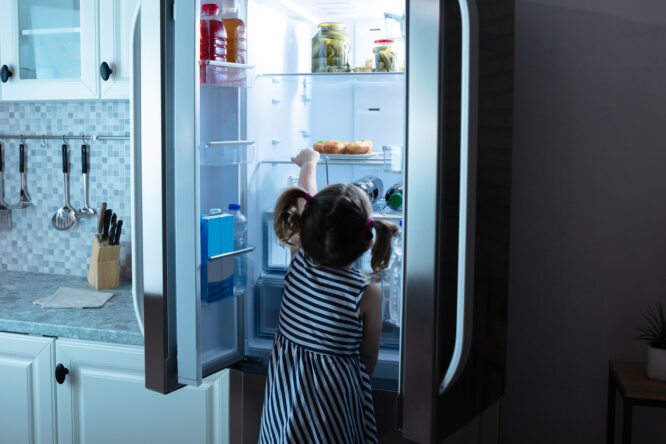
Said specifically when you’ve stood in front of the open fridge for more than four seconds, deciding what you fancy. Every British parent has the same internal alarm that goes off when a fridge door has been open too long, and they will appear from another room to deliver this line with surprising urgency, as if cold air is some finite resource, and you’ve just thrown away the family’s last reserves.
The mad thing is, you’ll spend your whole childhood mocking these phrases, and then one day you’ll find yourself saying every single one of them to your own kids, in the exact same tone, and possibly while wearing a fleece you swore you’d never wear. The script is bigger than any one of us. It’s how British parents survive, communicate, and quietly bond across generations, and it’s a tradition that shows absolutely no sign of going anywhere.