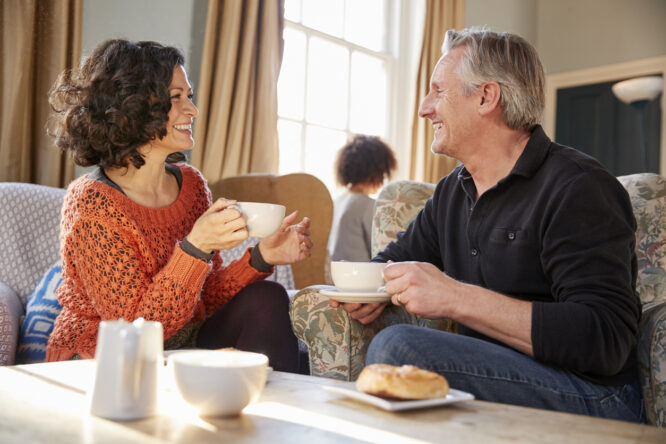
By the time you hit your 50s, a marriage has usually survived enough chaos to either be rock-solid or held together by nothing but habit and a shared Google Calendar.

When the kids finally bolt and the house goes quiet, a lot of couples realise they’ve been living parallel lives under the same roof, using the parent identity as a shield to avoid facing each other. Suddenly, you’re looking across the dinner table at a person who feels like a stranger, and the realisation that you could have another 30 years of this silence is what makes some people feel completely trapped.
Grey divorce is on the rise for a reason—it’s the point where the cost of staying starts to feel higher than the terrifying prospect of starting over. However, it’s not always the end of the road; for some, this stage is less of a cage and more of a pause where you finally get to bin the performance and build something that actually fits who you are now, rather than who you were at 25.
Marriages change shape slowly rather than all at once.

Most long marriages don’t just implode overnight. They drift, slowly, over years that nobody really notices passing. The big shared job of raising kids, paying off the mortgage, and getting on with work fills up most of the first few decades, and the relationship hides behind all of that for a long time. Then the kids leave home, work slows down or settles, the mortgage is paid off, and suddenly, there’s not much left to talk about.
Plenty of couples in their 50s look up after a busy 25 years of family life and realise they’re sitting across the table from someone they barely know any more. It’s a subtle shock, and it doesn’t show up in wedding photos or family albums, but it’s really common, and people are only just starting to talk about it openly.
Many people start feeling trapped for reasons they can’t immediately pinpoint.
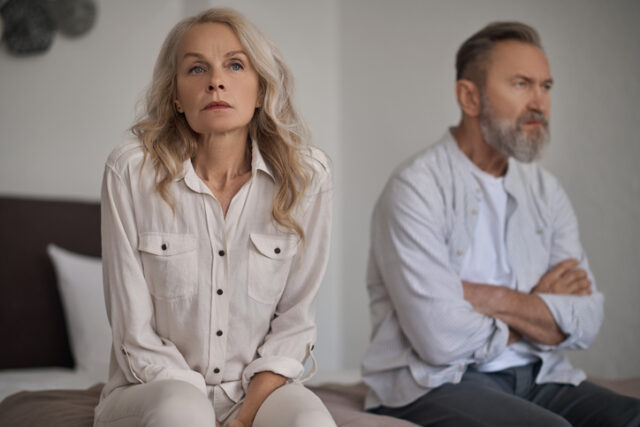
That trapped feeling usually comes from a few directions at once. There’s the money side, especially for women who took time out to raise kids and now feel they couldn’t easily start over on their own. There’s the friends and family side, where you’ve spent years building a life with shared mates, shared routines, and shared in-laws, and pulling all of that apart feels too big to face.
There’s the practical side, where the house, the pension, the holidays, and the family dog are all wrapped up together. And then there’s the emotional side, where you might still really care about your partner, but no longer feel like you’re properly living. Lots of people stay because leaving feels enormous, and because they’re not sure what they’d be leaving for. That doesn’t make the feeling of being stuck any less real.
The empty nest moment makes a big impact.

The empty nest is often the moment a marriage gets a hard look. While the kids were around, the marriage had a job to do, and the daily noise of school runs, packed lunches, teenage moods, and weekend plans gave the whole thing structure. Take the kids out of the picture and it goes very quiet very quickly.
Some couples find they actually really like each other and step into the next phase with a bit of excitement. Others find themselves face to face with someone they’ve been parenting alongside but not really talking to in any deep way for years. The emptiness of the house can mirror the emptiness of the relationship, and a lot of people describe it as a kind of grief. The marriage they thought they had isn’t quite there any more, or maybe never really was.
The “silent marriage” is a reality for many.

Therapists have started using the phrase “silent marriage” to describe what a lot of long-term couples settle into. It isn’t horrible. Nobody’s shouting, nobody’s slamming doors, there’s been no big betrayal. However, it’s not really a marriage in the warm sense, either. The two people are basically running parallel lives under one roof, eating dinner in front of the telly without much to say, going to bed at different times, taking holidays separately, doing their own thing at weekends.
They’re more like polite housemates than partners. Plenty of people are willing to live like this for years, often because the alternative feels worse and because there’s still affection underneath the silence. Of course, it’s a particular kind of lonely, and a lot of people who eventually leave a long marriage say the silent years were harder than the divorce itself.
The grey divorce numbers speak for themselves.

The numbers on this have been quietly piling up. Divorces among people over 50 have roughly doubled since 1990, and for people over 65 they’ve roughly tripled. While younger people are actually divorcing less than they used to, the over-50s are bucking the trend completely. Around a third of all divorces now involve someone over 50, and about two-thirds of those splits are started by the woman.
People are calling it grey divorce or silver splitting, and the numbers suggest something real is changing in how older couples think about the second half of their lives. The shame around divorce has faded, women have more money of their own than any generation before them, and people are living longer, which means staying in something unhappy could mean another 20 or 30 years of it.
Women are usually the ones leaving.

The fact that women start most of these splits surprises a lot of people, especially given that women usually come out of divorce worse off financially. The honest reason seems to be that women are often the ones who notice the emotional disconnect first, and after years of trying to fix things, gently bring things up, or just put up with things, they get tired of being the only one doing the work.
Many describe years of asking for change and not getting it. Others describe slowly realising the partnership had become wildly unequal, with them holding the family, the house, the social calendar, and most of the emotional load while their partner just pottered along next to them. By their 50s, with the kids gone and a sense that life is genuinely shorter than it once seemed, plenty of women decide they’re not willing to spend their remaining years being quietly resentful.
The retirement collision causes big problems.

Retirement is another point where marriages can wobble. After decades of being apart for most of the day, suddenly being together for breakfast, lunch, and the rest of the afternoon is a lot. Old frustrations that were easy to ignore over a phone call now sit at the kitchen table all day.
Differences in how each person wants to spend their retirement, whether that’s travelling, moving somewhere quieter, picking up new hobbies, or just sitting on the sofa, can spark proper rows. Some couples adjust beautifully and rediscover each other. Others realise they’ve been quietly avoiding each other for years, and the avoidance was the only thing holding the marriage together.
Health and caregiving can cause a major strain on long marriages.

Illness is another thing that doesn’t get talked about enough. As people get older, the chances of one partner developing a long-term health problem go up, and the strain of caring for them can change the marriage in deep ways. Studies have suggested that nearly a third of later-life marriages where one partner becomes seriously ill end in divorce.
That’s not always heartlessness; it’s often years of built-up exhaustion, money worries, lost closeness, and the slow realisation that a marriage of two has become a marriage of one carer and one patient. It’s a hard truth nobody likes to admit, but it’s part of why some people start feeling trapped, and why some eventually leave.
Some couples actually thrive in this stage.

It’s worth saying that not everyone over 50 is miserable. Loads of long marriages get genuinely better in this phase, and some couples describe their 50s and 60s as the best years they’ve had together. The ones who thrive tend to share a few things in common. They’ve kept properly talking through the busy years rather than letting things pile up.
They’ve used the empty nest as a fresh start rather than a sentence. They’ve put effort into staying interested in each other as people, not just as parents or providers. They’re realistic about what marriage actually is, rather than chasing the idea that it should always feel like new love. None of this is rocket science, but it does take attention, and plenty of couples stop paying attention somewhere around their tenth anniversary and never start again.
What the unhappy ones actually want

People who end up leaving long marriages rarely say they wanted anything dramatic. The reasons they give are surprisingly small and human. They wanted to feel seen. They wanted someone to actually listen. They wanted to laugh together more. They wanted to feel wanted, or at least liked. They wanted to be a person, not just a wife or a husband or a mum or a dad.
The grand gestures aren’t the point. It’s the steady, low-level loneliness of living with someone who stopped being properly curious about you a long time ago. When people in their 50s start daydreaming about being on their own, it’s almost never about wild new lives. It’s usually about peace, breathing room, and the quiet hope of feeling alive again.
Staying or going is a real quandary for many.

If you’re reading this and recognising your own marriage in any of it, the honest answer is that there isn’t one right move. Some marriages can be brought back to life with proper effort, often with the help of a good couples therapist who can tell the difference between fixable patterns and stuff that’s never going to change.
Some marriages are genuinely better ended, especially the ones where one or both people have been quietly miserable for years. The choice isn’t really between staying and leaving. It’s between drifting on autopilot or actually facing what’s going on. That can lead to a renewed marriage, or it can lead to a separation, but either of those is better than another decade of silent misery.
Marriage after 50 is more honest than the version we sold ourselves in our 20s. The romance fades and gets replaced by something quieter, sometimes deeper, sometimes thinner. Some couples find that the second half of life together is the bit they were always working towards. Others find they’ve been drifting for so long they barely recognise what they’re standing on.
Neither outcome is a failure. The kindest thing you can do, for yourself and for your partner, is to actually look at what you’ve got rather than keep your head down for another 20 years and hope it sorts itself out. It usually doesn’t.