Scrolling through social media right now can feel like looking at a gallery of identical clones.
A specific, hyper-polished look—dubbed the “Stacey face”—has completely taken over online culture, pushing a single, narrow ideal of female beauty that feels entirely synthetic. With its distinct mix of cartoonishly high cheekbones, unnaturally plump lips, and a completely frozen forehead, this digital template is flattening individual charm into a repetitive, mass-produced aesthetic.
While filters and cosmetic tweaks promise a boost in confidence, the reality behind this trend is far darker. By rewriting what we consider attractive, the unstoppable obsession with an artificial standard is doing serious damage to how women view themselves in the real world.
What ‘Stacey face’ actually is
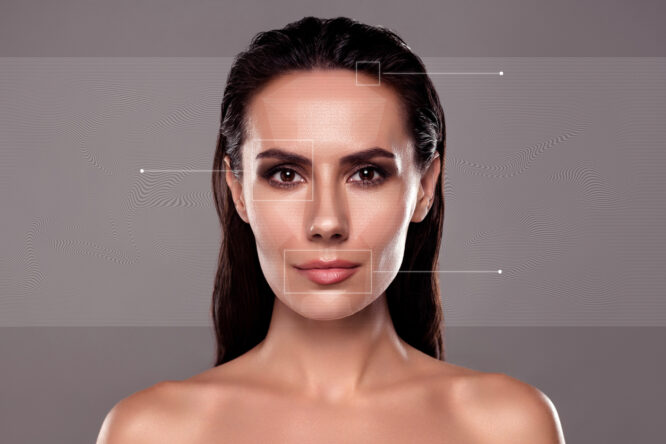
The term “Stacey,” or “Stacy” in the US, originated in manosphere communities online to describe what they consider the most attractive tier of woman. The look comes with a strict checklist of features: big eyes, high cheekbones, a low BMI, an upturned nose and full pouty lips. Anyone falling outside the template, according to these forums, gets demoted to the much less glamorous label of “Becky,” meaning average.
Over the past couple of years, the language has bled out of niche online spaces and into the mainstream internet vocabulary. Looksmaxxing, the practice of doing whatever it takes to push your appearance towards a supposed peak version of yourself, was initially associated with young men chasing chiselled jawlines and chin extensions. Now women are increasingly chasing the Stacey ideal too, often with the help of tools that simply didn’t exist a few years ago.
Unsurprisingly, AI is amplifying the trend.

This is where things get particularly worrying. AI tools like Elon Musk’s Grok, along with apps such as Umax and Glowdess, will happily generate an “improved” version of your face in seconds. Upload a selfie, and you’ll receive a glossy, smoothed, often unrecognisable version of yourself along with a detailed list of supposed flaws and recommendations to fix them.
The recommendations don’t just stop at suggesting a new lipstick. AI tools are routinely pointing users towards procedures like nose jobs, tear-trough filler, mid-face filler, and jaw refinement. They’ll even rate your current face out of ten and tell you exactly how much higher your score could go with the right surgical interventions. For young people who already feel insecure about their appearance, that kind of instant, brutal critique is genuinely damaging.
It’s doing major damage to young users.

Some of the most concerning activity is happening on Discord chatrooms and Reddit forums, where girls as young as 13 and 14 are asking for advice on how to “ascend” into a Stacey. They submit photos for strangers to dissect, share before-and-after AI-generated images, and discuss everything from extreme dieting to hairline-lowering surgery.
Eighteen-year-old looksmaxxing influencer Alorah Ziva has built a following of around 250,000 on Instagram and offers to teach fans how to follow her path for $79 a month. The growing visibility of these influencers means even children who aren’t actively seeking out the content can find themselves swept into it through algorithmic recommendations. Once the door is opened, the rabbit hole goes deep, with each new piece of advice nudging users towards more drastic measures.
Psychologists are worried about the effect it’s having on women as a whole.

Psychotherapists who specialise in body image have flagged the rise of looksmaxxing as a serious mental health concern. People most likely to be affected by these trends are those already lacking a solid, diverse sense of self-worth. The desire to “fix” your appearance often masks a deeper deficit in confidence that can’t be solved by surgery, filler, or chewing gum for a year.
There’s also the issue that looksmaxxing has no natural endpoint. It only works if you’re constantly improving, which means users get caught in an endless cycle of identifying new flaws and chasing new fixes. The industry behind it has every reason to keep that cycle spinning, since each new insecurity is another opportunity to sell another product or procedure. Girls are now worrying about their underarms, ears, chins and hairlines, with companies waiting to sell solutions for every one of them.
The role of selfie culture

Research has consistently shown that people who frequently take and post selfies report lower body satisfaction, higher anxiety and lower self-confidence than those who scroll passively. Looksmaxxing essentially takes that self-objectification and turbocharges it, encouraging users to view their faces as projects to be optimised rather than features to be lived with.
Body image researchers say that even positive feedback on these forums increases appearance investment and body image concerns. The very act of focusing intensely on appearance, whether the verdict is good or bad, makes the problem worse. The healthier approach, experts suggest, is to shift focus away from appearance altogether and celebrate people for who they are rather than what they look like.
Plastic surgeons are seeing the impact.

The flow from AI apps to surgeon’s offices is happening in real time. Plastic surgeons have reported a noticeable increase in patients arriving with AI-generated images, asking for the exact procedures their app suggested. In some cases, clients have requested implants in their chin, cheeks, and jaw all at once, based purely on what the algorithm told them.
No reputable surgeon would actually carry out that combination of procedures, since the result would be over-contoured to the point of looking strange rather than enhanced. The problem is that AI doesn’t understand the line between subtle improvement and disaster, and inexperienced patients often don’t either. Surgeons are now spending more time managing expectations and explaining why chasing an AI-generated face isn’t a realistic or even desirable goal.
Why the standards are so impossible
Thirty or so years ago, the beauty standards we compared ourselves to came from a small handful of celebrities or the most attractive person in our local area. Today, we have billions of filtered, edited and AI-enhanced faces at our fingertips, all available for instant comparison. The result is a standard that no real human can actually meet, since most of the faces we’re measuring ourselves against aren’t real either.
Looksmaxxing pushes the comparison to its extreme. By promising users they can become a “10 out of 10” if they just follow the right regime, it sets up a goal that’s mathematically impossible to reach. Even the influencers selling the dream are themselves filtered, edited and surgically altered. The carrot keeps moving, and the people chasing it keep paying.
Where the law is lagging behind
Other countries are starting to take steps to protect younger users from this kind of content. Australia and the EU have introduced stronger protections around children’s use of the internet, including stricter age verification and limits on certain types of content. The UK government has been slower to act, prioritising business growth and AI development over the safety concerns of young people online.
Psychotherapists working with young patients warn that this “wait and see” approach could leave a generation paying the price. Once self-worth has been eroded by years of online comparison and AI-driven critique, the road back through therapy and treatment can be long and expensive. Prevention, in this case, is far better than cure.
What you can do to protect yourself
Stepping away from looksmaxxing apps and AI face raters is one of the simplest and most effective things you can do. Deleting the apps from your phone removes the temptation to check in and submit yourself for another round of criticism. Curating your social media feeds to include diverse, unfiltered faces also helps recalibrate what real beauty actually looks like.
If you’ve got teenagers in your life, having open conversations about how AI tools work, and how their outputs can be biased and harmful, is one of the most useful things you can do. Show them how easily a photo can be manipulated, and how the “perfect” faces they see online are usually anything but real. Helping young people build self-worth around things other than appearance, like creativity, kindness, humour and friendship, gives them something far more solid to stand on than any algorithm-approved face.
The protective power of being average

One of the most interesting points raised in conversations about beauty standards is the idea that being considered average can actually be a protective factor. Therapists who work with patients struggling with body image often see two groups affected most. Those labelled the pretty or athletic ones throughout childhood, and those labelled the opposite. Both groups can end up overly identified with their appearance, for different reasons.
Sitting somewhere in the middle, free from the pressure of constant compliments or constant critique, often makes it easier to build identity around character traits instead. Humour, intelligence, kindness, talent, the ability to make people laugh or feel comfortable, all of these tend to grow stronger when appearance isn’t the loudest voice in the room. Being a Becky, in other words, might be the secret weapon nobody is talking about. And in a world increasingly obsessed with optimising every angle of every face, that’s a thought worth holding onto.