You’ve probably heard it before catching yourself doing it.
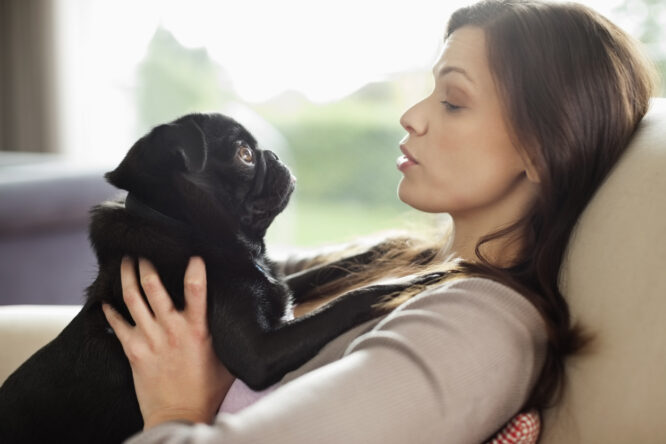
The moment a dog bounds into the room, our normal speaking voice completely vanishes, and we’re suddenly cooing in an absurd, high-pitched squeak. You’d never dream of talking to your colleagues or mates like that, yet with four-legged companions, it happens purely on instinct before we’ve even had time to think about it. It might sound completely ridiculous to anyone listening in, but evolutionary biologists and animal behaviour experts have found that this strange human habit is actually rooted in real science, and your dog is paying far closer attention to those silly tones than you might expect.
We all switch into this voice automatically, and for good reason.

When talking to babies or animals, most people instinctively raise their pitch and add a sing-song quality to their speech. It works a bit like waving your arms to catch someone’s attention, an unconscious signal meant to draw focus. Humans tend to switch into a warmer, more expressive tone whenever addressing someone who might not fully grasp what’s being said. That transition grabs attention and immediately signals friendliness, whether the listener is six months old or covered in fur.
Baby-talk carries an extra job that pet-talk doesn’t.

With infants, evolution seems to have layered on something additional. Beyond simply sounding warm, baby-talk actively supports language development by making individual speech sounds clearer and easier to distinguish. That teaching component largely disappears once the listener has four legs instead of two. Pet-talk functions mainly as a form of connection, a way of communicating attentiveness and safety, rather than passing along any linguistic lesson.
Stripped of words, both styles sound remarkably alike.
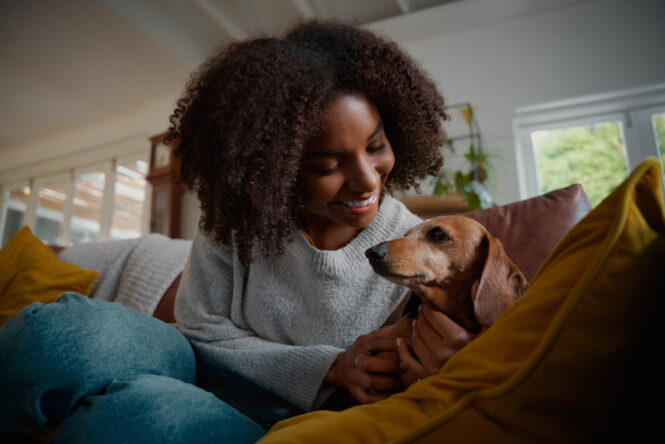
When researchers strip away the actual words and isolate only the melody of speech, both baby-talk and pet-talk rate as noticeably friendlier and more affectionate than ordinary adult conversation. On a purely musical level, they’re difficult to tell apart. However, subtle differences do emerge once you dig deeper. A 2024 study compared how warmly women spoke to their babies versus their dogs, drawing on participants who had only a baby, only a dog, or both.
Having both a baby and a dog changes the pattern.

Among women who had only one or the other, warmth levels stayed roughly equal whether they were addressing a child or an animal. However, something changed for women who had both. Their voices toward their babies grew notably warmer compared to how they spoke to their dogs.
Interestingly, their pet-directed speech also came out slightly less warm than that of women who only owned a dog and had no baby at all. This points to something worth flagging: pet-talk seems considerably more flexible than baby-talk, adjusting depending on what else is competing for a person’s attention, while the warmth directed at infants stays remarkably consistent regardless of circumstance.
Only one of these actually teaches language.

There’s another meaningful distinction beyond warmth. When adults speak to babies, they’re simultaneously teaching, often without realising it. Parents commonly exaggerate vowel sounds, drawing out a word like “sheep” so the “eee” sound becomes unmistakably clear.
This technique, called hyper-articulation, makes individual sounds far easier for infants to pick apart and process. Children whose caregivers rely on this pattern frequently tend to develop larger vocabularies later on, suggesting this small vocal habit plays a real role in shaping early language skills.
Pets don’t get the same clarity boost.

When researchers went looking for hyper-articulation in speech directed at animals, they found almost none. Cats and dogs receive plenty of pitch, bounce and emotional warmth, but the crisp, exaggerated pronunciation reserved for babies simply doesn’t carry over.
Parrots, however, turned out to be something of an exception. One study found that people naturally spoke to dogs in a warm, affectionate tone, but adjusted their speech to sound slightly clearer when addressing parrots, animals famously capable of mimicking human speech. Babies still received the fullest version of that clarity, suggesting a rough hierarchy: dogs get affection, parrots get a hint of coaching, and infants receive the complete educational package.
Puppies actually prefer being spoken to this way.

Does any of this matter to the animals themselves? A 2017 study found that puppies showed a clear preference for recordings of pet-directed speech over standard adult conversation, moving toward the speaker faster and staying attentive for longer stretches. Adult dogs displayed a similar preference too, though somewhat less pronounced than their younger counterparts.
There’s also evidence this vocal style improves communication in practical terms. In one experiment, dogs searching for hidden food located it more successfully when a pointing gesture was accompanied by a high-pitched voice rather than a flat, neutral tone.
Other people notice and appreciate it too.

It isn’t just animals who respond positively. A 2026 survey found that more than three-quarters of pet owners recalled their vet using a friendly, pet-directed tone during a recent appointment, and most described genuinely valuing it, feeling it reflected real care for their animal on the vet’s part.
This warm speaking style extends well beyond cats and dogs, too. A 2021 study found that horses spoken to in this manner paid closer attention to their handler and performed noticeably better at following human pointing gestures to locate hidden food, suggesting the effect isn’t limited to household pets at all.
It’s an old system doing double duty.

So next time you overhear someone telling their dog they’re “the best dog in the whole world,” recognise it for what it actually is: an ancient communication system built around warmth, attention and social connection. Babies simply receive an enhanced version of that same system, one that not only expresses affection but also quietly lays the groundwork for language itself.