More than half of people in the UK say they’d support cigarette-style warning labels on packets of bacon, ham, and sausages, according to a recent poll.

It’s a striking finding, and one that reflects how much public awareness has changed around processed meat and health in recent years. The comparison to cigarette warnings might sound a bit over-the-top, but it’s rooted in something the World Health Organisation said back in 2015, which is that cured and processed meats carry a cancer risk comparable to tobacco and asbestos. That classification hasn’t gone away, and the debate around what to do about it is getting louder.
Processed meat in this context means anything that’s been preserved through salting, curing, smoking or adding preservatives. Bacon, ham, sausages, hot dogs, salami, and pepperoni all fall into this category. These are foods most people in the UK eat regularly, often without thinking much about what’s in them or what long-term consumption might mean for their health.
What actually makes processed meat a concern?
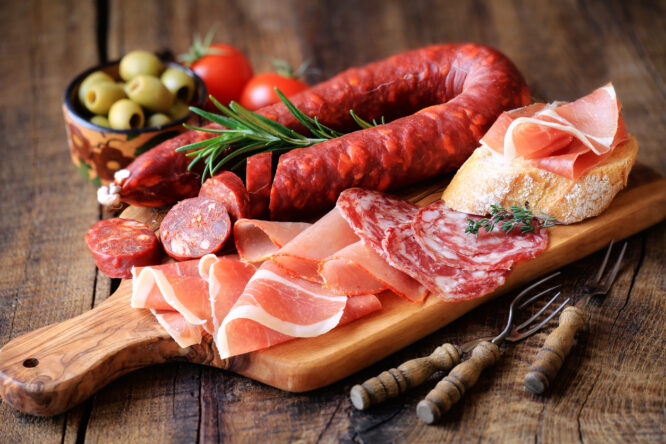
The main issue that health researchers point to is nitrites. These are chemical compounds used in the curing process that give bacon and ham their pink colour, extend shelf life, and prevent bacterial growth. The problem is that when nitrites interact with the proteins in meat during cooking or digestion, they can form compounds called nitrosamines, which are known to be carcinogenic. The bowel in particular appears to be vulnerable to this effect, which is why processed meat is most strongly linked to bowel cancer risk.
The Coalition Against Nitrites, which campaigns for tighter regulation of these chemicals in food, has pointed to data suggesting that more than 50,000 bowel cancer cases in the UK over the last decade are linked to processed meat consumption. That’s not a trivial figure, and it’s part of why campaigners are pushing for the same kind of bold health messaging on meat packaging that transformed public attitudes to smoking over several decades.
How much processed meat is too much?

Current NHS guidance recommends that people who eat more than 90 grams of red or processed meat a day should cut down to no more than 70 grams. To put that in perspective, two rashers of bacon weigh roughly 60 grams, and a couple of sausages take you well past 70 grams on their own. For people who eat a cooked breakfast several times a week, have a ham sandwich for lunch most days, and add sausages to a dinner a few times a month, staying under that threshold is harder than it sounds.
The risk isn’t binary; eating a bacon sandwich occasionally doesn’t carry the same weight as eating processed meat every single day for decades. However, the evidence consistently shows that regular, high consumption over a long period does meaningfully raise the risk of bowel cancer specifically, and the effect appears to be dose-related, meaning the more you eat and the more often, the higher the risk climbs.
More and more people are becoming aware of the risks.

Awareness has been growing but remains patchy. The poll that found 55% support for warning labels also found that among people who were already aware of the health risks, 84% said they had changed their behaviour as a result, buying less processed meat, switching to nitrite-free options, or cutting it out altogether. That’s a high proportion of people acting on information once they have it, which is essentially the argument for putting clearer information on packaging in the first place.
The problem is that a large chunk of the population still doesn’t connect their daily bacon sandwich with an elevated cancer risk. Smoking took decades of public health campaigning, graphic packaging, and restricted advertising before attitudes truly changed. Processed meat hasn’t had anything close to that level of sustained messaging, which is why campaigners argue that labelling is a necessary next step rather than an extreme one.
Warning labels on these products could be a good thing.

The argument in favour of putting health warnings on processed meat packaging is fairly straightforward: people deserve to know what they’re eating and what the evidence says about it. Nobody is proposing to ban bacon. The suggestion is that the same right to informed choice that applies to cigarettes, alcohol, and other products with documented health risks should also apply to cured meat. If the information changes what people buy, that’s the point — it means the warnings are working.
Campaigners also argue that when a chemical is no longer necessary for food production, there’s no justification for continuing to use it. Nitrite-free versions of bacon, ham, and sausages do exist and are increasingly available in supermarkets, which raises the question of why the default version still contains a compound linked to cancer when an alternative is available and commercially viable.
The case against labels, and the industry’s position, can’t be ignored.
The meat industry and some food scientists push back on the framing, arguing that the risk associated with moderate processed meat consumption is much smaller in absolute terms than comparisons to tobacco suggest. Smoking dramatically raises the risk of multiple cancers across a lifetime of use. The increased risk from eating processed meat, while real, is considerably smaller in scale, and presenting the two as equivalent can create disproportionate fear.
There’s also the question of what nitrites actually do in terms of food safety. They inhibit the growth of Clostridium botulinum, the bacteria responsible for botulism, which is a serious and potentially fatal illness. Removing nitrites from all processed meat without a reliable alternative preservation method carries its own risks, which is part of why the food industry has been cautious about making wholesale changes even as pressure has mounted.
Nitrite-free meat is an option, but it’s not quite that simple.

Nitrite-free bacon and ham have become more widely available over the last few years, and for people who want to reduce their exposure while still eating these foods occasionally, they’re a reasonable option. However, it’s worth knowing that some products labelled as nitrite-free use ingredients like celery powder or celery juice as a curing agent, and these naturally contain high levels of nitrates that convert to nitrites during the curing process. The end result can contain similar levels of nitrites to conventionally cured meat, just without it being listed as an additive on the label.
The Food Standards Agency has been clear that switching to nitrite-free processed meat doesn’t eliminate the health risks associated with high consumption of processed meat more broadly. The nitrite question is one part of a more complicated picture, and anyone making dietary changes purely on the basis of a nitrite-free label should understand that the reassurance it offers is more limited than it might appear.
What does the evidence actually recommend?

The most consistent message from health organisations is that occasional consumption of processed meat as part of an otherwise balanced diet carries a manageable risk, but that eating it regularly and in quantity over a long period is worth taking seriously. Reducing how often you eat processed meat, keeping portions modest when you do, and building meals around vegetables, pulses, and less processed protein sources are all steps the evidence supports.
None of this requires cutting bacon out of your life entirely, and that’s probably not a realistic goal for most people anyway. What it does suggest is that treating processed meat as an everyday staple rather than an occasional food isn’t supported by the current evidence, and that being more aware of how frequently it features in your diet is a reasonable thing to think about. The debate over warning labels is really just a debate about how loudly and clearly that message should be delivered, and whether the food industry should be required to deliver it themselves.