If you’ve noticed your pint doesn’t pack quite the same punch as it used to, you’re not imagining things.
Faced with soaring production costs, heavy duty rates, and inflation, breweries across the UK are quietly lowering the alcohol content of their popular beers while keeping the price at the bar firmly unchanged. Dubbed “drinkflation,” this subtle tactic lets brands shave a fraction of a percent off their ABV to save millions in taxes, all while hoping customers don’t read the fine print on the tap head or bottle. Brewers are tweaking their recipes to protect their margins—here’s which famous pints have taken a quiet hit, and what it means for your local pub bill.
What is drinkflation, really?

Drinkflation is the drinks industry’s answer to the more familiar trick of shrinkflation, where a bag of crisps gets a little lighter while the price on the shelf stays exactly where it was. Instead of shrinking the product itself, brewers are cutting how strong the drink actually is, all while the can stays the same size and costs exactly what it did before the change.
It’s a subtle enough change that most people simply won’t clock it happening. Nobody weighs their beer, and unless you’re paying close attention to the small print on the label, a can that’s gone from 4.0% down to 3.4% looks identical to the one that came before it.
Carling is the clearest example right now.
The most notable case at the moment is Carling Original, which is having its strength reduced from 4.0% alcohol by volume down to 3.4%. That’s not a trivial cut either, it’s a meaningful drop in strength for one of the country’s biggest selling lagers.
The change won’t actually take effect until October, so anyone drinking Carling today is still getting the original strength for now. Once it lands, though, it’ll apply across the board, with no separate labelling or pricing to flag that anything’s different.
Carling isn’t the only brand doing this.
This isn’t a one-off move by a single brand chasing a quick saving. Foster’s has already dropped from 4.0% to 3.4% over the past few years, and Sol made a similar cut from 4.2% down to 3.4% back in 2025. Carlsberg, Grolsch, John Smith’s, Coors, and Amstel have all quietly trimmed their alcohol content too, following essentially the same pattern.
It’s tempting to assume there’s a health angle here, that brands are responding to drinkers wanting something lighter, or even trying to nudge the nation toward drinking a bit less overall. Neither explanation actually holds up, though. In reality, it comes down to something far simpler, and far less altruistic, than any of that.
The real reason comes down to tax.
It isn’t the alcohol itself that costs breweries money to produce, it’s the tax attached to it once it’s bottled or canned. Changes to alcohol duty introduced back in 2023 mean that packaged beer sitting between 3.5% and 8.4% ABV gets taxed at £22.58 per litre of pure alcohol, a rate that applies regardless of exactly where in that band a beer falls.
For a standard 4.0% beer, that works out to roughly 41p a pint in duty alone, a cost that gets baked into what breweries pay before a single can even reaches the shelf. Drop the strength down to 3.4% though, and the duty falls sharply to £9.96 per litre of pure alcohol, working out at closer to 19p a pint. That’s less than half the tax bill per pint, which explains why so many brands have landed on exactly the same 3.4% figure, rather than it being some strange coincidence.
Why 3.4% specifically keeps coming up
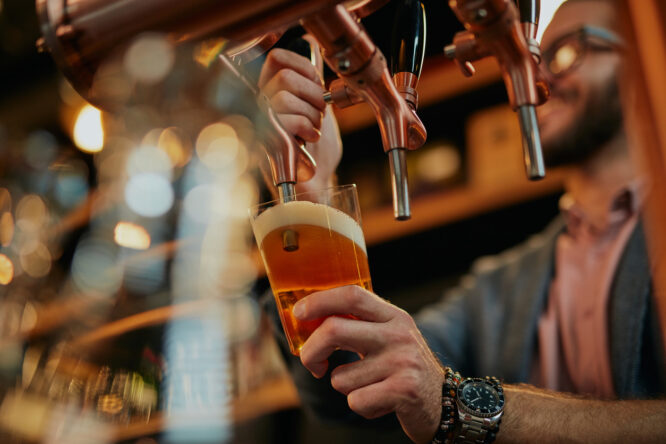
The repeated appearance of 3.4% across so many different brands isn’t random. It sits neatly below the threshold where the higher rate of duty kicks in, meaning brewers get the maximum tax saving available without dropping the strength any further than they strictly need to.
Cutting alcohol content any more than that would start to noticeably change how a beer tastes and feels to drink, so 3.4% has effectively become the sweet spot. It’s the lowest strength brands can land on while still saving significantly on tax and, in their view, keeping the drink recognisably similar to what it was before.
Will drinkers actually notice, or care?

Carling has pushed back on the idea that weaker automatically means worse, pointing to its own consumer testing, where the 3.4% version reportedly scored higher for overall taste than the original stronger recipe. Whether that holds up to wider scrutiny once drinkers get their hands on it more broadly in October remains to be seen, since in-house taste tests and public opinion don’t always line up.
The brand also laid some groundwork earlier in the year, launching a stronger, pricier Black Label version at 4.7% back in February. That move effectively built a value-to-premium ladder within the same brand, giving drinkers who specifically want a stronger beer somewhere else to go, rather than losing them to a rival entirely once the standard version gets weaker.
What this means next time you’re at the bar
For most casual drinkers, this change will likely pass by completely unnoticed, since nothing about the price, packaging, or shelf placement gives any obvious clue that something’s changed. The only real way to spot it is checking the ABV printed on the can itself, something most people rarely think to do.
For anyone who does pay attention to strength, whether for taste, budget, or simply wanting to know what they’re actually drinking, it’s worth keeping an eye on those percentages over the coming months. As more major brands follow the same pattern, the classic pint might be quietly getting less potent across the board, even while everything else about it looks exactly the same as before.