Making a solid espresso has always relied on a strict golden rule.

That is, you have to shoot near-boiling water through finely ground beans under massive pressure to get that rich, dark shot with a thick layer of crema on top. Trying to make one with cold water usually leaves you with a sour, watery mess that no coffee lover would ever touch.
However, a brilliant breakthrough has completely turned traditional brewing on its head. By using ultra-fast sound waves to blast open the coffee grounds instead of heat, a team of researchers managed to extract the full, bold flavour of an espresso using freezing cold water. Funnily enough, people actually loved it.
The experiment was a challenge to the status quo.

A team at UNSW Sydney started with a deceptively simple question: does espresso actually need hot water to taste like espresso? It sounds almost obvious that the answer would be yes, given that heat has always been central to how espresso machines work. Their new research suggests otherwise, and the method they developed to test the idea is genuinely unusual. Rather than adjusting temperature or pressure in the traditional sense, they turned to sound.
How does ultrasonic espresso actually work?
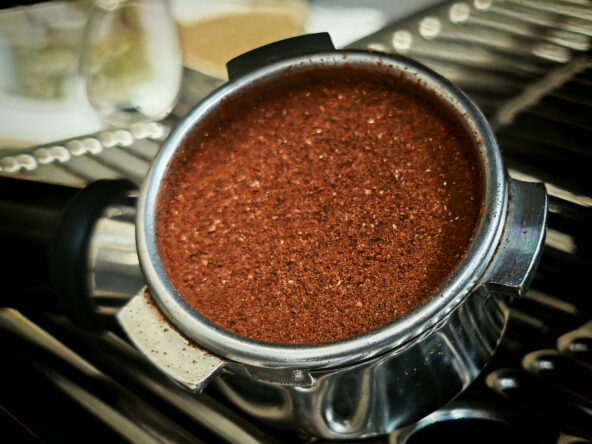
The team created what they call ultrasonic espresso, a process that brews coffee at room temperature using high-frequency sound waves instead of heat. A small metal device called a transducer is pressed against the side of a standard espresso basket, causing it to vibrate at a speed far beyond what the human ear can detect.
Those vibrations travel through the water and coffee grounds, creating tiny bubbles that rapidly form and collapse inside the liquid. When these bubbles collapse close to coffee particles, they produce forces strong enough to fracture the surface of the grounds and push flavour compounds, oils, and caffeine into the water much faster than would ever happen naturally at room temperature.
This is completely different from cold brew.

Cold brew coffee also uses room temperature water, but the similarity pretty much ends there. Cold brew typically involves steeping coffee grounds in cold water for anywhere between 12 and 24 hours, producing something smooth and mellow that’s far less concentrated than espresso.
Ultrasonic espresso is done in under three minutes and aims to match the full strength, body, and intensity of a traditionally made shot, which is a much harder target to hit than simply making a cold coffee taste pleasant over a long brewing time.
Getting the recipe right takes precision.

Hitting that target required the team to carefully adjust several variables throughout the process. The ratio of water to coffee mattered a great deal, since too much water weakened the drink and too little made extraction difficult to achieve consistently.
Grind size played a role too, with finer grounds allowing flavour to be extracted more quickly under the sound waves. After testing different durations, researchers found the sweet spot landed somewhere between two and a half and three minutes of ultrasound, long enough to extract everything needed without overdoing it.
What happened when real coffee drinkers tried it?

Getting the science right in a lab is one thing, but the team knew the real test was whether ordinary coffee drinkers would actually accept the result. They ran a blind tasting with around 100 regular coffee drinkers, people who drink coffee at least once a week but aren’t trained professional tasters.
Each person was served four coffees in identical cups: a traditional espresso, an ultrasonic espresso, a traditional filter coffee, and an ultrasonic filter coffee, all cooled to the same temperature and presented in random order. For the espresso samples, participants couldn’t reliably tell the two apart, with no major differences detected in aroma, flavour, bitterness, or overall enjoyment.
The filter coffee result was even more interesting.

While the espresso results showed the two versions were essentially indistinguishable, the filter coffee comparison produced a mildly unexpected outcome. Participants actually preferred the ultrasonic filter coffee overall, rating its bitterness as more pleasant than the traditional version.
This hints that the ultrasonic process might do something subtly different to how certain compounds are extracted, potentially offering more control over the final flavour profile than conventional brewing methods allow.
The energy saving benefit actually has uses outside of the home kitchen.

For anyone making a single coffee at home, saving energy by skipping the heating element might not feel like a big deal. The picture changes in a big way when you scale up to industrial coffee production, where energy costs and processing times have a real impact on how drinks are made and shipped around the world.
The researchers estimate the ultrasonic process could save up to 75% of the energy normally used in espresso brewing. A concentrated room-temperature coffee could be used directly in bottled drinks, milk-based products, or cold coffee lines, and could also be shipped as a concentrate and diluted later, potentially cutting both energy use and processing time at scale.
What this could mean for coffee’s future

This research doesn’t mean espresso machines are about to disappear from kitchen counters anytime soon. The ultrasonic setup currently requires a transducer attached to a standard espresso basket, which isn’t exactly plug-and-play for most people at home yet.
But the findings do challenge a long-held assumption about what espresso actually needs to be espresso, and that kind of question, once answered, tends to open doors. If sound waves can replace heat without anyone noticing the difference in their cup, the way coffee is made at scale could look quite different within a few years.