Not everyone who’s been through childhood trauma makes it obvious in their adult life.

You might have terrible memories or carry around emotional scars, but they’re only noticeable in subtle behaviours and patterns that aren’t easily spotted, not even by you. The things you learned to do to survive emotionally, mentally, or even physically don’t just disappear. They evolve into habits, coping mechanisms, or emotional responses that can feel frustrating or confusing until you realise where they came from. These are just some of the ways childhood trauma often shows up later in life, even when you don’t realise it.
1. You’re always saying “I’m sorry” even when you’ve not done anything wrong.

People who grew up walking on eggshells often learned that saying sorry was the fastest way to avoid punishment, conflict, or tension. Now, as an adult, that reflex sticks, even in moments where you haven’t actually done anything wrong. It’s not that you lack confidence; it’s that your nervous system still thinks keeping the peace means keeping yourself safe. Over-apologising becomes less about guilt and more about trying to control outcomes you fear.
2. You just can’t bring yourself to ask for help, even when you could really use it.

If you were taught, directly or indirectly, that your needs were too much, you probably learned to become self-reliant early on. As an adult, asking for help might feel weak, embarrassing, or even dangerous. This can leave you exhausted, silently overwhelmed, or even resentful of those who don’t seem to carry the same weight. But underneath that independence is often a simple truth: no one showed up when you needed them, so you stopped expecting it.
3. You assume people will leave you.
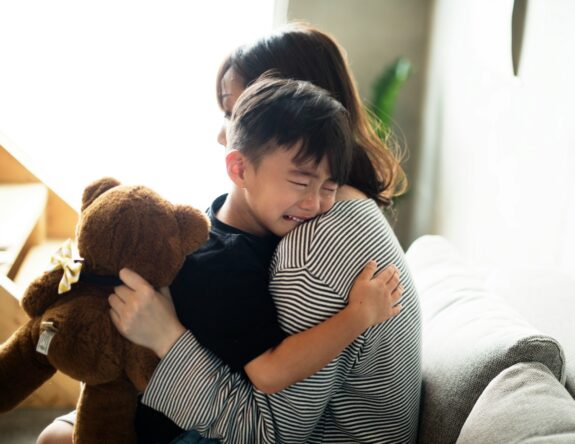
Abandonment in childhood, whether emotional, physical, or both, can teach you that closeness comes with risk. So even when someone is consistent and kind, part of you might still brace for the moment they walk away. Sometimes you sabotage good connections because leaving first feels safer than being left again. Other times, you stay overly guarded, never fully letting people in. Either way, you’re not protecting yourself from love; you’re protecting yourself from loss.
4. You minimise your own pain.

If your hurt was ignored, mocked, or punished growing up, you likely learned to downplay it. Now, you might say things like “it’s not a big deal” or “other people had it worse” without even realising how often you invalidate yourself.
This creates an emotional disconnect, where you feel pain but never allow yourself to fully acknowledge or process it. And over time, that unprocessed pain doesn’t go away; it just changes form, often showing up as anxiety, depression, or chronic stress.
5. You expect chaos when things are calm.

If your early environment was unpredictable, calm might not feel comforting. Instead, it might feel suspicious. You’ve been trained to associate peace with “the calm before the storm,” and your nervous system stays on high alert, waiting for something to go wrong. This can make stable relationships feel boring, or safe people feel untrustworthy. It’s not that you want drama; it’s that your brain doesn’t fully believe in emotional safety because it never got to experience it for long.
6. You attach quickly, then panic.

For some, childhood trauma creates an anxious attachment style, where connection feels both essential and terrifying. You might get deeply attached quickly, then feel overwhelmed, afraid, or suddenly distant once real closeness sets in. This push-pull dynamic isn’t dramatic. It’s about your body not knowing whether love means comfort or danger. That confusion can make relationships feel intense, unstable, and deeply exhausting.
7. You become hyper-independent.

If the adults in your life weren’t emotionally available, you probably learned to handle everything alone. Now, you pride yourself on being strong and low-maintenance, but deep down, you might still long for connection you’re too afraid to ask for. Your self-sufficiency is often misunderstood as confidence, but it can be a trauma response. It says, “If I don’t need anyone, I can’t be disappointed.” However, it also creates loneliness that other people might never see.
8. You’re constantly afraid of being “too much.”

If expressing big feelings got you punished or ignored, you probably started hiding parts of yourself to stay safe. Now, you might downplay excitement, anger, sadness, or even happiness because you’re afraid of overwhelming people or being rejected. That fear can make you shrink in conversations, avoid taking up space, or second-guess your emotions constantly. Of course, the root of it is rarely shame; it’s protection. You learned that survival meant being palatable.
9. You overthink every social situation you experience.

When you grow up in an unpredictable or critical home, you often learn to scan for signs that something’s wrong. That hypervigilance doesn’t disappear; it just worms its way into relationships, where you replay conversations and read too deeply into neutral responses.
The mental loop is exhausting, but it’s rooted in a survival strategy. You learned to stay emotionally safe by predicting other people’s moods. Now, even when things are fine, your brain keeps looking for signs of rejection or danger.
10. You’re triggered by emotional closeness.

You may crave intimacy deeply but feel activated when it actually happens. Being seen, cared for, or even just understood can feel overwhelming if those things weren’t safe growing up. This shows up in subtle ways, like pulling away after a good date, picking fights when things are going well, or freezing when someone says something kind. Emotional closeness can feel like walking into a room that once held fire, even if it looks peaceful now.
11. You have a hard time trusting kindness.

If love in your childhood came with conditions, manipulation, or pain, you might not believe in kindness without strings. When someone is genuinely nice, part of you questions their motives, or prepares for the moment they turn. This mistrust isn’t bitterness. It’s what happens when care has been used against you. It takes time to learn that kindness doesn’t have to be a trap, and that not everyone who’s warm is hiding something underneath.
12. You put everyone else’s needs first.
Childhood trauma often teaches kids to be caretakers, especially in emotionally unstable homes. As an adult, this turns into chronic people-pleasing, over-functioning, and feeling guilty for having boundaries. You don’t do it because you want approval; you do it because, deep down, you learned that keeping everyone else happy was the safest way to avoid pain. But that same instinct can leave you burnt out, resentful, and disconnected from your own needs.
13. You carry shame that doesn’t belong to you.

Even if nothing was your fault, trauma has a way of planting shame in the people it touches. You might carry guilt, self-loathing, or an unshakeable feeling that something is wrong with you, even when everything on the outside looks fine. That internal narrative often started young, shaped by how other people treated you. Until it’s challenged, it can influence everything from your relationships to your self-worth without you even realising it.
14. You mistake intensity for love.

When love was mixed with chaos, neglect, or emotional highs and lows, your nervous system learned that intensity equals connection. As an adult, calm love might feel unfamiliar or even suspicious, like something must be missing. This makes it hard to recognise healthy relationships. You might find yourself chasing passion, drama, or emotional rollercoasters, not because you enjoy them, but because that’s what love felt like before.
15. You struggle with self-worth even after success.

No matter how much you achieve, part of you still feels like it’s not enough. That’s because trauma often roots itself in how you see yourself, not how the world sees you. So even with praise, awards, or recognition, that deep insecurity lingers. Still, it can make it hard to enjoy your own life. You might feel like a fraud, push yourself too hard, or struggle to rest because your worth still feels tied to how much you produce or prove.
16. You’re deeply empathetic, but often exhausted by it.

Growing up around emotional unpredictability can make you incredibly sensitive to other people’s moods. You probably pick up on subtle changes, notice discomfort before other people do, and feel deeply tuned in to what people aren’t saying. While that empathy is powerful, it can also leave you drained, especially if you don’t know how to set emotional boundaries. Your ability to care runs deep, but so does the weight of carrying everyone when no one taught you how to put it down.