Buddhist monk Yongey Mingyur Rinpoche has been described by researchers as one of the happiest people ever studied.
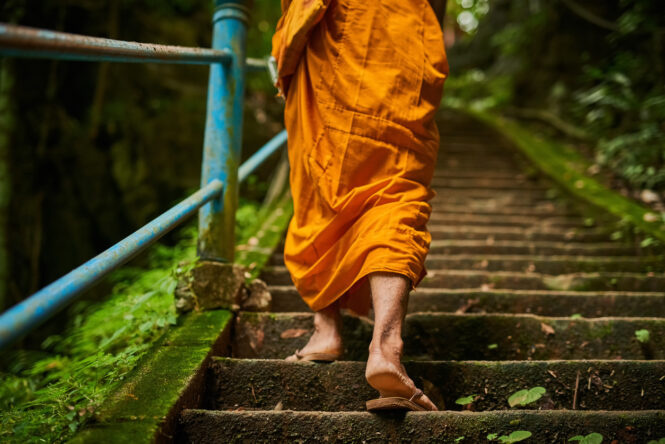
Brain scans have shown unusually high activity in the part of his brain linked to positive emotion, and at 41, his brain reportedly showed patterns closer to someone eight years younger. He also laughs a remarkable amount. So what’s his actual approach to a happier life? Here are nine of his core ideas.
Convenience isn’t the same as contentment.

Mingyur points out that modern life gives us instant access to almost anything, so the moment we feel bored, lonely or unsettled, we reach for a quick fix instead of actually sitting with the feeling. Whether that’s food, a phone, or endless scrolling, we tend to treat uncomfortable emotions as problems to escape rather than signals you should be paying attention to.
If you’ve ever found yourself bored while watching something and scrolling your phone at the same time, that’s a pretty clear sign that adding more stimulation isn’t going to fix the underlying restlessness. Research on social media use backs this up too, since constantly flicking between short videos tends to make people more bored, not less. Instead of reaching for another distraction, the suggestion is to switch everything off and sit with the discomfort for a moment.
Change is easier to handle than we think.

Back in 2011, Mingyur left his monastery in the middle of the night with nothing but the clothes he was wearing, planning to live as a wandering yogi with no fixed home. A few weeks in, he became seriously ill with food poisoning and spent days in pain and exhaustion, but he now views that period as the point he truly understood the Buddhist idea of letting go of control.
You don’t need anything quite that extreme to build comfort with change, though. Big life transitions, like starting a new job or a new relationship, naturally offer opportunities to grow more comfortable with uncertainty. But smaller changes work too. Trying a new route home, cooking with an unfamiliar ingredient, or meeting a new group of people can all help build the same muscle, without waiting for a major life event to force the issue.
You don’t need silence to meditate properly.

Mingyur admits he found meditation boring when he first started learning it, repeating the same breathing exercises day after day with little variation. His view now is that meditation doesn’t require perfect stillness or silence. Almost anything around you, traffic noise, other people talking, even chaos, can become something to focus on rather than something that disrupts your practice.
The suggestion is to build up gradually, starting with something calming like music, then moving toward background noise like a busy street or loud conversation, until distraction itself becomes part of the practice rather than an obstacle to it.
Mindset, practice, and habit all work together.

Tibetan Buddhism generally breaks things down into three connected pieces: your underlying mindset, your meditation practice, and how you actually apply what you’ve learned day to day. The idea rests on the belief that everyone holds an inner capacity for awareness, compassion and wisdom, but simply believing this isn’t enough on its own.
It has to be built through repeated small habits. Rather than assuming people generally aren’t kind, you might make a conscious effort to notice good qualities in others, one day appreciating a family member, the next actively finding something positive to say about a difficult colleague. Over time, this kind of small, repeated practice is what actually changes your outlook.
Gratitude works best when it’s specific.

Gratitude journalling has become something of a cliché, but there’s a more effective version of it worth trying. Rather than writing broad, general statements, the idea is to notice small, specific things: having your senses intact, having shelter, having even one or two people in your life who care about you.
This doesn’t necessarily need to be a formal journalling habit either. After a few days, generic gratitude entries can start to feel automatic and lose their meaning. Instead, try pausing in small everyday moments, like sitting somewhere comfortable, or watching a child play, to notice how good that specific moment feels.
Difficult emotions pass, even when they feel permanent.

Mingyur has spoken about experiencing panic attacks as a young man, and asking his father, who first taught him meditation, how to fight them. His father’s advice was simple: don’t fight them at all. Actively resisting a feeling tends to make it stronger, in the same way that being told not to think about something makes it nearly impossible not to.
The comparison he uses is a storm cloud passing across the sky. The cloud doesn’t change the nature of the sky itself, it simply passes through and moves on. Whatever emotional turmoil you’re experiencing doesn’t fundamentally change who you are, it will eventually pass. In moments of real distress, when this feels impossible to remember, focusing on physical sensations instead, the temperature of the room, background sounds around you, can help you get through the moment without needing to convince yourself everything is fine.
Chasing happiness directly tends to backfire.

According to Mingyur, real happiness comes from letting go of the constant sense that something is missing, rather than actively chasing happiness itself. Plenty of people assume they’ll be happy once they earn more money, move somewhere new, or land a better job, but these changes typically only change our mood temporarily before we settle back to roughly where we started.
Instead, the suggestion is to build breathing, compassion and love into a regular practice, which can change your baseline level of contentment over time, rather than just briefly boosting your mood. A simple starting point is to sit and breathe naturally, paying attention to your breath, while mentally repeating a phrase wishing yourself wellbeing, before gradually extending that same wish outward to loved ones and eventually, everyone around you.
Anger doesn’t need to be fought, just noticed.

Mingyur compares awareness to sunlight and emotional patterns like anger to morning frost. Once the sun comes out, frost melts naturally without any real effort or struggle involved. He’s worked with stressed business leaders who’ve built anger or constant stress into a daily habit simply from juggling too much at once, and his advice to them is consistently the same: notice the anger the moment it appears, sit with it briefly, and that awareness alone often creates space for it to change.
In practice, this doesn’t require a lengthy meditation session. The next time you feel a flash of irritation at work or at home, rather than reacting on autopilot, simply notice that you’re angry and watch what happens next. It takes practice to get right, but it’s a habit worth building.
Helping others creates a different kind of happiness.

Mingyur points out that helping someone else produces a noticeably different, often deeper, form of happiness compared to smaller everyday pleasures like a treat or a coffee. It’s something most of us already know deep down, yet rarely put into practice as often as we could.
A simple place to start is checking in on someone nearby who might need it, whether that’s a neighbour, a friend, or a family member going through a difficult stretch. Sometimes the smallest gestures end up making the biggest difference, both to the person receiving them and to your own sense of contentment.