With the warm weather sticking around, plenty of us are reaching for the ice cream tub more often than usual.

It sounds like the kind of thing you’d feel guilty about, but some experts reckon a scoop or two might not be doing you as much harm as you’d think, and could even come with a few genuine upsides. Here’s what’s actually going on, plus how ten popular supermarket tubs stack up when you look past the label.
Not all ice cream is created equal.

A lot of the ice cream sold in supermarkets is packed with emulsifiers, stabilisers, artificial flavourings, and thickening agents, which puts it firmly in the ultra-processed camp. That’s the kind of thing most of us are better off eating less of. But ice cream made the traditional way, using just milk, cream, sugar, eggs and natural flavourings like vanilla or real fruit, doesn’t fall into that category, and dietitians say it can absolutely have a place in a balanced diet.
One dietitian put it simply: ice cream was never going to be a health food, but that doesn’t automatically make it a bad one either. A couple of scoops of good quality dairy ice cream still gives you calcium, protein and some useful vitamins, so it’s not just empty calories.
There’s an unexpected link between ice cream and diabetes risk.

There’s a well-known piece of research, sometimes called the ice cream effect, that found men who ate ice cream a couple of times a week had a noticeably lower risk of developing type 2 diabetes than those who didn’t. It’s one of those findings that seems to go against everything you’d expect. A separate study also found that people with diabetes who ate a modest daily portion appeared to have a lower risk of heart problems.
Not everyone is convinced this proves ice cream itself is doing the protecting. Some researchers point out that people who enjoy the odd ice cream tend to differ from those who don’t in plenty of other ways too, from their general diet to their income and lifestyle, any of which could be influencing the results.
Ice cream might not spike your blood sugar the way you’d expect.

Part of the explanation could come down to fat content. Traditional ice cream is high in fat, and that fat slows down how quickly your stomach empties, which in turn slows how fast sugar hits your bloodstream. That gives it a surprisingly moderate glycaemic index, lower in fact than jacket potatoes or some wholegrain bread. One American cardiologist has even started recommending a small bowl of vanilla ice cream topped with almonds or strawberries as a sensible dessert option for his patients.
Frozen yoghurt and sorbet aren’t automatically the healthier choice.
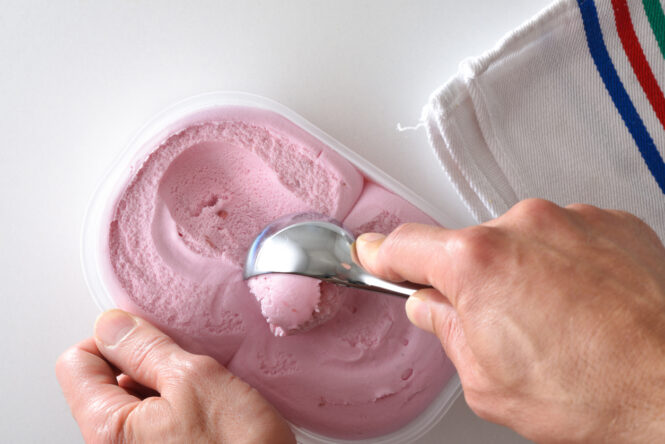
It’s easy to assume frozen yoghurt or sorbet are the safer options, but that’s not always true. Frozen yoghurt often uses milk instead of cream, which does cut the fat, but some brands make up for the milder taste by adding extra sugar. Sorbet has a similar problem. It can look like the virtuous choice sitting next to a rich vanilla, but plenty of sorbets are little more than sugar and water, and some so-called diet ice creams lean heavily on sweeteners and stabilisers instead.
Most nutritionists agree on one thing, regardless of the science. Ice cream makes people happy, and that counts for something too. Enjoying a treat without guilt is part of what a genuinely balanced approach to eating looks like.
How the supermarket tubs actually stack up

A nutritionist worked through ten popular supermarket ice creams, scoring each one out of five based on ingredients and nutritional content. The pattern was clear: the shorter the ingredients list, the higher the score tended to be.
Booja-Booja Deeply Chocolate – 5/5
Dairy free and cashew based, with a rich chocolate flavour and nothing artificial added. Per 100ml it has 166kcal, 7.1g fat, 2.3g of which is saturated, and 19g sugars, keeping saturated fat impressively low for a chocolate ice cream.
M&S Only 5 Ingredients Heather Honey – 5/5
Just milk, cream, honey, milk powder and egg, with no refined sugar anywhere on the label. Saturated fat sits at 10.5g per 100g, but the short ingredients list makes it about as close to homemade as a shop bought tub gets.
Häagen-Dazs Vanilla – 4.5/5
Five ingredients and nothing else: cream, milk, sugar, egg, and vanilla. Saturated fat runs on the higher side at 10.4g per 100g, but there’s nothing hidden in the recipe.
Duchy Organic Vanilla – 4.5/5
Cream, milk, sugar and Madagascan vanilla, with no gums or stabilisers. Saturated fat is high at 8.1g per 100g, which comes with the territory for a truly dairy heavy recipe.
Remeo Pistacchio Siciliano – 4.5/5
Pistachio paste, egg yolk, milk and cream, plus a single stabiliser. Per 100g it has 132kcal, 5.6g fat, 2.3g saturated, and 13g sugars, lower in saturated fat than most of the cream-based tubs on this list thanks to gelato’s milk heavy method.
Booja-Booja Chocolate Salted Caramel – 4/5
A vegan option built around cashews, cane sugar and cocoa. Per 100ml it has 169kcal, 6.2g fat, just 1.3g saturated, and 21g sugars, an unusually low saturated fat count offset by a fairly high sugar content.
Yeo Valley Organic Blueberry & Lemon Curd – 4/5
Sugar, egg, milk and cream form the base, with real fruit providing the flavour rather than concentrate. Saturated fat comes in at 7.7g per 100g, with a moderate 23.1g sugars.
Hackney Gelato Alphonso Mango Sorbetto – 3.5/5
Made with 38 per cent real mango and completely dairy free. Per 100g it has just 115kcal and 0.3g fat, but 23g sugars, actually higher than several tubs rated lower on this list, coming from three different sugar sources.
Jude’s Salted Caramel – 2.5/5
Condensed milk, glucose-fructose syrup, an emulsifier and two stabilisers. Per 100ml it has 141kcal, 7.9g fat, 4.9g saturated, and 15g sugars, with a noticeably longer processing aid list than the tubs above.
Ben & Jerry’s Phish Food – 2/5
The highest sugar count on the list at 27g per 100g, alongside 273kcal and 8.9g saturated fat. Three separate stabilisers and multiple added sugars come from the chocolate, marshmallow and caramel combination.
Waitrose No.1 Belgian White Chocolate – 1.5/5
The worst scoring tub, with 294kcal, 19g fat, 12.1g saturated, and 26.6g sugars per 100g, roughly five times the saturated fat of the Booja-Booja options. White chocolate brings sugar and cocoa butter without any of the benefits found in dark chocolate.
There’s one thing worth to check before you buy.

Price and calorie count aren’t the only things worth glancing at next time you’re stood in the freezer aisle. A short ingredients list, ideally just milk, cream, sugar, and a handful of natural flavourings, tends to be a far better sign of quality than anything printed on the front of the tub. Marketing terms like “low fat” or “diet” don’t always mean fewer additives either, sometimes it’s the opposite.
None of this means ice cream belongs on a health food shelf. But a couple of scoops of something made properly, enjoyed now and then, isn’t the guilty pleasure it’s often made out to be.