We’ve all heard the stern warnings about how spending all day glued to a chair isn’t doing our health any favours.

Between commuting, eight hours at an office desk, and sprawling out on the sofa to catch up on telly in the evening, modern life practically demands that we stay off our feet. Plenty of us try to balance the books by sweating through a gym session or getting in a quick run, telling ourselves that an hour of solid effort wipes out an entire day of sitting down.
Fresh findings published in Plos Medicine suggest that mental arithmetic doesn’t hold up. How you clock up those sedentary hours carries far more weight than the total time stamped on your smartwatch. Parking yourself in one spot for an unbroken four-hour stretch appears to be massively harder on your heart, circulation, and metabolism than accumulating the same desk time with short but regular breaks in between. The good news is you don’t need to completely overhaul your daily grind or purchase an expensive treadmill desk; simply changing how you pace your day could make all the difference to your long-term health.
Long, unbroken sitting seems to be the real problem.

Researchers found that every extra hour spent sitting in one continuous stretch was linked to a meaningfully higher risk of both developing and dying from cancer. According to one epidemiologist involved in the study, sitting for more than 30 minutes at a time specifically appears linked to a higher cancer risk. The encouraging part is that breaking up that sitting time with something as simple as a short walk seems to offer real protection, even without doing anything particularly strenuous.
The study included nearly 100,000 people.

Researchers looked at data from over 91,000 people taking part in the long-running UK Biobank study, which has been tracking the health of roughly half a million people across the UK for years. Everyone involved was around 56 years old on average, and none had a history of cancer at the start.
Each participant wore an activity tracker on their wrist for a full week, which recorded whether they were sitting still or moving, and how intensely. Researchers then followed up on everyone’s health for around 12 years afterward, tracking who went on to develop cancer, and who sadly died from it.
Not all sitting turned out to be equal.

Overall, people who spent more time sitting throughout the day tended to have worse health outcomes, including a higher chance of both developing cancer and dying from it, even after accounting for things like age, income, education, and lifestyle habits.
But when researchers looked more closely, they found a clear difference between two types of sitting. One was long, unbroken sitting, defined as 30 minutes or more spent almost entirely still. The other was sitting that got regularly interrupted by movement, even briefly. These two types of sitting turned out to affect health very differently.
Just one extra hour of continuous sitting made a real difference.

For every additional hour someone spent sitting in one long, unbroken stretch each day, their risk of dying from cancer rose by 9%. Their overall risk of developing cancer in the first place rose too, by around 3%, with cancers linked to obesity and type 2 diabetes specifically rising by about 5%. Those numbers might sound fairly small on their own, but they add up. Every extra hour spent sitting continuously stacks on top of the last, so the risk builds the longer someone stays still without a break.
Breaking up your sitting seemed to help.

The picture looked completely different for people who broke their sitting up regularly. Each hour of interrupted sitting, meaning sitting that included regular short bursts of movement, was linked to an 18% lower risk of dying from cancer, and a 6% drop in overall cancer risk.
Cancers linked to obesity and type 2 diabetes dropped too, by 9% and 10% respectively, among people who moved around regularly rather than staying seated for long, unbroken stretches. According to the researchers, this makes sense biologically, since earlier experiments have already shown that breaking up long periods of sitting with short bursts of activity improves how the body processes things like blood sugar, compared to sitting still the whole time.
Even light activity made a positive difference.
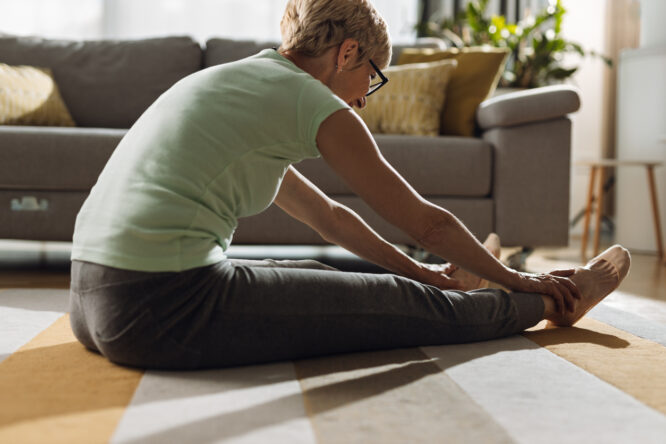
The study also found that swapping just one hour of continuous sitting each day for some light physical activity was linked to real health improvements. Doing this was associated with a 12% lower risk of dying from cancer, and a 6% drop in overall cancer risk. According to one of the researchers, most current health advice focuses heavily on moderate or intense exercise, but these findings suggest even light movement shouldn’t be overlooked or dismissed as a waste of time.
What this actually means for you

It’s important to remember that this type of study can only show a link between behaviour and health outcomes, it can’t prove for certain that changing how you sit will directly lower your own personal cancer risk. Still, these findings line up with other research showing links between too much sitting and chronic inflammation, along with wider evidence around how staying active can help protect against cancer more generally.
Even small amounts of movement that break up long periods of sitting seem to make a real difference to overall health, and that’s something to keep in mind next time you catch yourself glued to a chair for hours on end. Getting up for even a minute or two every half hour, whether that’s making a cup of tea, stretching, or just wandering around the room, could be worth doing.