
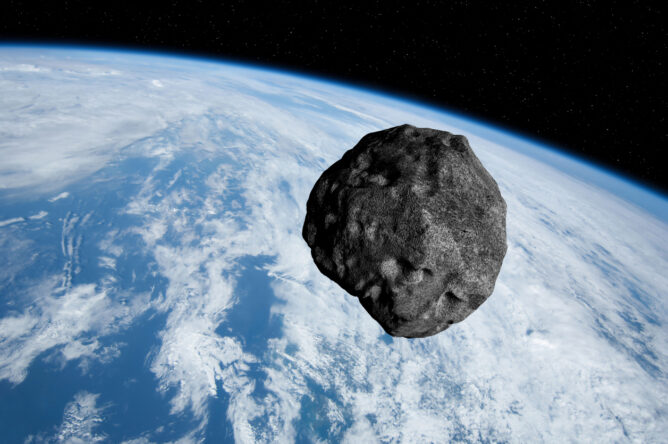
In April 2029, a huge asteroid is going to fly incredibly close to Earth, close enough that scientists have spent years double-checking the numbers just to be sure it won’t hit us. It won’t, but there’s a strange twist to this story that has nothing to do with the asteroid threatening Earth, and everything to do with Earth threatening the asteroid.
What’s actually happening in 2029?
The asteroid in question, called Apophis, is a chunk of rock roughly 370 metres long, similar in scale to a large skyscraper. On the 13th of April 2029, it’s going to pass within about 32,000 kilometres of Earth, which sounds enormous but is actually remarkably close in space terms, closer than many satellites currently orbiting our planet.
Scientists are confident there’s no danger to anyone on Earth. Instead, this flyby is being treated as a rare scientific opportunity, since Earth’s gravity will be strong enough during the close pass to actually reshape the asteroid, potentially triggering landslides or tremors on its surface and revealing what’s hidden underneath.
Why space junk suddenly became a concern
Two spacecraft, one from Europe and one from NASA, are being sent specifically to watch this transformation happen up close and in detail. But researchers studying the flyby realised there was a problem nobody had considered before: the sheer amount of human made debris currently floating around Earth.
One of the scientists behind the new study specialises in both asteroid movement and space debris, and started wondering whether Apophis might actually cross paths with some of that junk on its way past. Given how much debris now orbits our planet, it seemed worth checking properly rather than assuming it wasn’t an issue.
There’s a surprising result nobody expected.
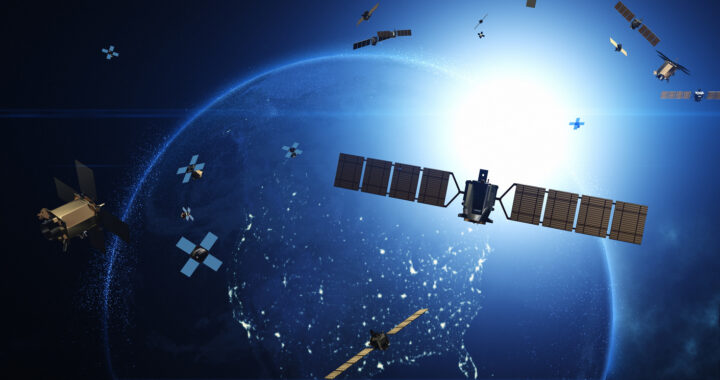
Most human made debris orbits far closer to Earth than where Apophis will be passing, so researchers expected to find nothing to worry about. Instead, running the numbers revealed a small but real chance that a piece of debris sitting in a specific orbital band, the same region used by many communication satellites, could actually collide with the asteroid.
That band sits at an altitude of roughly 36,000 kilometres, where objects orbit at the same speed Earth rotates, meaning they stay fixed above the same spot on the ground. It’s a heavily used area of space, and the researchers found that when you factor in both the tracked debris and the debris we don’t currently know about, a collision becomes a real possibility rather than a purely theoretical one.
To be clear, a collision wouldn’t be catastrophic.
To be clear, this isn’t a situation like NASA’s famous DART mission, where a spacecraft was deliberately crashed into an asteroid to change its path. Any accidental impact from space debris wouldn’t meaningfully alter Apophis’s trajectory at all.
The realistic outcome would likely be a small crater forming on the surface, along with a plume of debris flying off from the impact point. In some ways, this could even be useful, potentially giving the two spacecraft extra material to study, and instruments planned for the mission might even be able to detect the vibrations from such an impact.
So, what’s the problem, then?
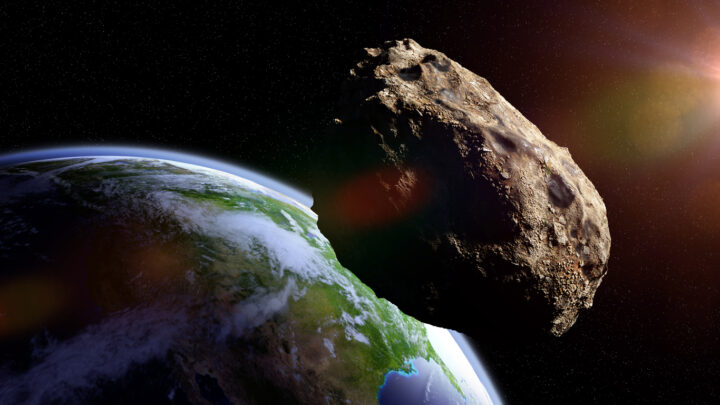
The real concern isn’t damage, it’s confusion. Scientists are hoping to carefully observe exactly how Earth’s gravity reshapes Apophis during the flyby, and an unexpected collision beforehand could make it far harder to work out which changes came from Earth’s gravity and which came from getting hit by debris.
Untangling those two effects afterwards would be a tricky scientific puzzle, potentially muddying results that researchers have been waiting years to properly observe. It should be noted that this kind of impact wouldn’t set off a dangerous chain reaction of debris colliding with more debris, since the region Apophis passes through is far less crowded than the busier orbits closer to Earth.
This reveals a lot about space debris tracking.
Perhaps the most important takeaway from all this is how little we actually know about smaller debris sitting in these higher orbits. While large satellites and bigger chunks of space junk are tracked fairly reliably, plenty of smaller fragments remain essentially invisible to current monitoring systems.
Researchers behind the study hope this unusual flyby will add extra motivation to improve that tracking before 2029 actually arrives. New surveillance telescopes are already being planned as part of a wider European space monitoring system, specifically designed to build a clearer picture of what’s actually orbiting in these higher, harder to track regions of space.
