Deciding how to support a family member who can’t quite manage on their own anymore is one of the heaviest choices you’ll ever have to make.

It’s a deeply personal crossroads where the comfort of staying in a familiar home clashes with the 24-hour security and social life that a dedicated care facility provides. With the UK’s care system under more pressure than ever, understanding the actual day-to-day reality of both options is the only way to cut through the guilt and find a path that actually works for everyone involved.
While one person might thrive in the structured, communal environment of a residential home, another might find that losing their own front door is a hit to their independence they’re not ready to take. Before you commit to such a massive life change, it’s worth weighing up the practicalities, the costs, and the emotional impact of both live-in support and residential care to see which one truly fits your family’s needs.
What is a care home?
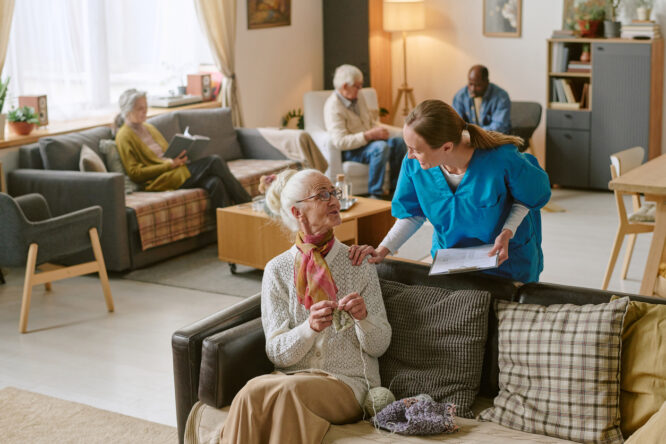
A care home is a residential facility where your loved one moves in full-time and receives round-the-clock support from staff on site. There are two main types in the UK. Residential care homes provide personal care, help with daily tasks, meals, and companionship, but they don’t have nurses on site. Nursing homes offer everything a residential care home does, plus access to qualified nurses who can manage more complex medical needs. Some homes provide both types of care under one roof, which can be useful if a person’s needs are likely to increase over time.
More than 400,000 older people currently live in care homes across the UK, and the sector is large and varied. Quality ranges enormously from one home to the next, and the Care Quality Commission rates all registered homes in England, which is a useful starting point when comparing options. The best homes tend to have waiting lists, so starting that search earlier rather than later is always advisable.
What is live-in care?
Live-in care means a professional carer moves into your loved one’s home and provides continuous, one-to-one support. The carer lives in a spare room and is present throughout the day and on call overnight, covering personal care, medication prompts, meal preparation, mobility support, companionship, and help with household tasks. It’s a model that’s grown in a big way in the UK over the past decade as more families look for alternatives to residential care that allow their loved ones to stay at home.
Most live-in care arrangements involve the carer working six days a week with rest periods built in, with cover provided by a relief carer when needed. Some people require two carers working in rotation, particularly where care needs are complex or where someone needs repositioning through the night. The level of care provided can be adjusted as needs change without the upheaval of moving to a different setting.
How much does each option cost in 2026?

Cost is usually the first question families have, and the honest answer is that both options are expensive and getting more so. Care home fees in the UK have risen sharply in recent years. Average residential care home fees are now approaching £1,400 per week nationally, with nursing homes averaging around £1,558 per week. That puts the annual cost of a residential place at roughly £70,000 to £80,000 for many self-funding residents, and nursing home care can push well above that depending on location and the home’s quality.
Live-in care costs an average of around £1,200 to £1,500 per week nationally in 2026, with more complex care, such as advanced dementia or post-surgical recovery, pushing costs to between £1,600 and £1,800 per week. At first glance, the two options look comparable, but there are important differences in what the headline figures include and don’t include.
Care home fees frequently carry hidden costs that families don’t always anticipate. Room supplements for larger or en-suite rooms can add £100 to £400 per week. Personal extras including hairdressing, chiropody, toiletries, newspapers, and social outings are often billed separately. Contracts commonly include annual fee escalation clauses that can exceed inflation. If care needs increase, which they often do over time, fees can rise substantially with relatively little notice.
Live-in care costs tend to be more transparent, though families should factor in a contribution toward the carer’s food and household bills as part of the arrangement.
Which is better value for couples?
For couples who both need care, live-in care becomes much more cost-effective than a care home. A single live-in carer can support both partners in their own home for a single weekly fee, whereas a care home placement means paying for two separate rooms and two sets of fees. Many care homes also don’t allow couples to share a room, which adds an emotional dimension to the financial one. For a couple where both partners need support, live-in care can save tens of thousands of pounds a year while keeping them together in familiar surroundings.
How does each option affect quality of life?

This is where the two options diverge in the biggest ways, and it’s worth being honest about what the research shows. The overwhelming majority of older people say they want to stay at home for as long as possible. Familiar surroundings, personal possessions, established routines, and connection to their community all contribute to emotional well-being in ways that are difficult to replicate in an institutional setting.
For people living with dementia in particular, staying at home can make a meaningful difference. Research has shown that people with dementia who remain at home experience higher activity levels, better quality of life, and stronger social connectedness than those in institutional care. Being surrounded by familiar objects, photographs, and memories provides a form of orientation and reassurance that a care home environment can’t easily replicate. Familiar surroundings have also been shown to reduce nighttime confusion, which is one of the most challenging aspects of dementia for both the person affected and their family.
That said, a good care home offers things that live-in care can’t always match. Social interaction with other residents, structured activities, a sense of community, and the security of always having staff nearby can all majorly improve quality of life for people who thrive in a social environment or who would otherwise be isolated at home. Some people genuinely flourish in a care home setting, particularly if their home situation had become lonely or unsafe.
When is a care home the right choice?
There are circumstances where a care home is genuinely the more appropriate option, and it’s important to be clear-eyed about that. If someone needs 24-hour access to registered nursing care, clinical equipment, or a secure dementia unit, a nursing home will generally be safer and better equipped than live-in care can provide. If a person’s needs are escalating rapidly and unpredictably, a care home’s ability to scale support without disruption can be a real advantage.
A care home may also be the right choice if the person’s home is unsuitable for a live-in carer—too small, inaccessible, or in poor condition—or if living at home has become genuinely distressing rather than comforting. Some people with dementia reach a stage where they no longer recognise their home as home, which removes one of the main arguments for keeping them there. The Alzheimer’s Society notes that repeated falls, huge safety risks, rejection of help from carers, or the complete exhaustion of family carers are all signs that residential care may be the more sustainable option.
When is live-in care the right choice?

Live-in care tends to work best for people who are strongly attached to their home and community, who have complex but manageable care needs, and who would benefit from consistent one-to-one support from a familiar face. It’s particularly well-suited to people with dementia in the earlier to middle stages, people recovering from a stroke or surgery, people with Parkinson’s disease or other progressive conditions, and couples where both partners need varying levels of support.
The continuity of live-in care is one of its strongest arguments. In a care home, residents interact with multiple members of staff across different shifts, which can be disorientating for people with memory problems. A live-in carer gets to know the person’s routines, preferences, habits, and history in a way that builds genuine trust and comfort over time.
What funding is available?
For people who haven’t yet spent down their assets, care in the UK is largely self-funded. In England, if your savings and assets exceed £23,250 you’re expected to fund your own care. Below that threshold, your local authority will carry out a means test to assess how much support you’re eligible for. The threshold is £24,000 in Wales, and Scotland operates differently with free personal and nursing care available to all who are assessed as needing it, regardless of finances.
NHS Continuing Healthcare is worth exploring for anyone with primarily health-related care needs. It fully funds care in any setting, including at home, but eligibility requires a formal assessment and is granted only where health needs are the dominant factor. Attendance Allowance is available to people over 65 who need help with personal care and is not means-tested, currently worth up to £108.55 per week at the higher rate. It can be used toward either care home or live-in care costs.
If you own your home but have limited savings, deferred payment schemes allow care home fees to be charged against the property rather than requiring an immediate sale, giving families more time to make decisions without being forced into a rushed sale.
How to make the decision

The most useful starting point is a formal care needs assessment through your local authority, which is free and will give you a professional view of the level of support required. From there, getting detailed quotes from both care homes and live-in care providers, and making sure you understand exactly what is and isn’t included, will let you compare like with like rather than headline figures.
Visiting care homes in person before making any decisions is essential. CQC inspection reports are publicly available online and give a useful picture of how a home has performed, but there’s no substitute for walking through the door and getting a feel for how residents are treated, how staff interact with them, and whether the environment feels genuinely warm. For live-in care, asking providers how they match carers to clients and what happens when the primary carer is unavailable are important practical questions.
Wherever possible, the person needing care should be involved in the conversation. Their preferences, anxieties, and priorities matter enormously, and decisions made with their input rather than around them tend to produce better outcomes for everyone involved.