There’s something comforting about settling on the sofa after a long day and having your cat curl up beside you, purring away as it rests its head on your hand.

Most cat owners know that feeling well, but scientists are only now starting to understand what might be happening inside our bodies during these moments. A small study from Japan has found that cats and their owners may share a link in their levels of a feel-good hormone, and that this could be connected to how owners feel. The findings are early, but they offer an intriguing glimpse into the bond between people and their pets.
The hormones behind the bond
The researchers looked at two natural chemicals in the body. The first, oxytocin, is often called the bonding hormone because it tends to rise when we share affection, such as a hug or a cuddle, while the second, cortisol, is linked to how the body reacts to stress.
No earlier study had measured oxytocin in both cats and their owners at the same time, so this research was a first. Scientists wanted to see whether the closeness people feel with their cats might show up in these hormone levels.
How the study worked
The team recruited 19 cat owners and their 29 cats, and for the hormone comparisons, they used samples from 24 of the cats and 17 of the owners. They collected three urine samples from each person and cat and worked out an average level for each hormone.
Owners also filled in a questionnaire about how they’d been feeling over the previous few weeks. To track how much time owners and cats spent near each other at home, small tags on the cats’ collars sent signals to their owners’ phones.
What the researchers found
Owners with higher levels of oxytocin tended to have cats with higher levels too, suggesting the two may be linked. Cats with more oxytocin also had owners with lower levels of the stress hormone cortisol.
These owners reported feeling less anxious and less confused, although some other links, such as with low mood and anger, became less clear once the team took into account homes with more than one cat. Owners who spent more time close to their cats also said they felt more energetic, regardless of how many years they’d lived together.
Why stroking your cat might help

The researchers think stroking and cuddling could be part of the reason for the link. When an owner strokes their cat, oxytocin may rise in both of them, which could help strengthen their bond over time.
In a separate test, cats with higher oxytocin were more likely to walk up to a person sitting nearby, whether that was their owner or a stranger. That suggests the hormone might play a part in how friendly and sociable cats are.
What the study can’t tell us
This was a small study, and most of the owners taking part were women, so the results may not apply to everyone. It also compared average hormone levels rather than tracking whether they went up and down together over time.
Crucially, the study doesn’t prove that cats lower their owners’ stress because it’s also possible that people who already feel calmer and happier spend more time cuddling their cats. The tags couldn’t tell whether a cat was being stroked or simply sleeping nearby, so scientists say more research is needed, measuring hormones before and after cuddles, to understand what’s really going on.
Cats compared with dogs

Interestingly, the study found no clear link between cats’ and owners’ stress hormone levels. An earlier study on dogs did find a connection between stress hormone levels in dogs and their owners.
The difference could be down to the way the samples were collected, as owners gave their samples in the morning while cat samples were taken whenever possible. Because stress hormone levels naturally change throughout the day, this may have made any link harder to spot.
Building a closer bond with your cat
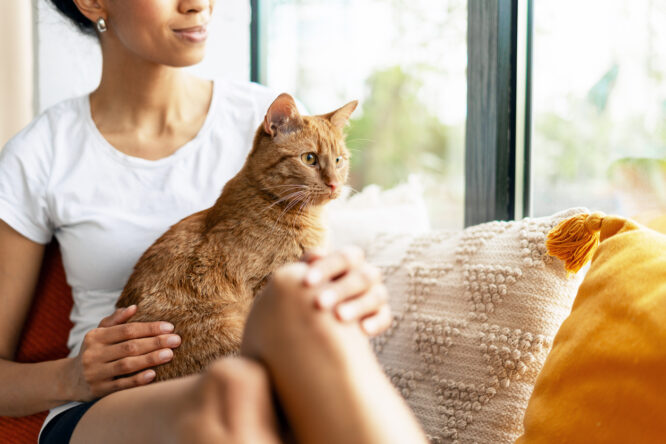
Every cat is different, so let yours decide when it wants a cuddle rather than picking it up when it isn’t in the mood. Many cats enjoy gentle stroking around their cheeks, chin, and the top of the head, and you can watch for signs such as purring, slow blinks or rubbing against you to know they’re enjoying it.
Regular play sessions, a calm routine and a quiet spot of their own can all help a cat feel safe and settled. While cats can be wonderful company, they aren’t a replacement for support from people, so if you’re feeling anxious or low for a long time, speak to your GP or a trusted friend.