Adult birthdays used to mean a few drinks at the local, a slice of cake, and a card through the letterbox.
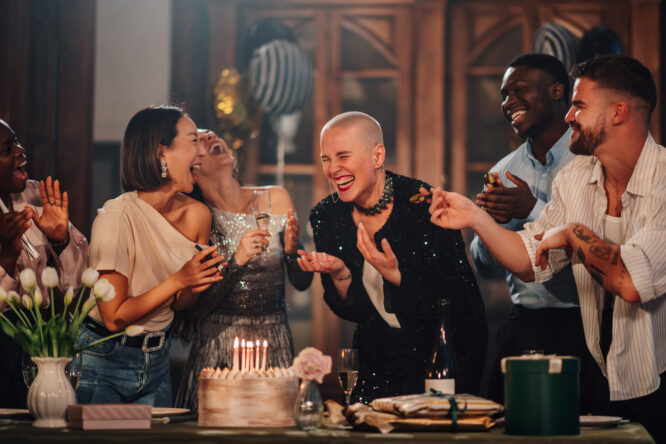
Now, they’re giving weddings a proper run for their money in terms of scale and expense, complete with custom dress codes, branded goody bags, full-blown mini festivals, and elaborate weekend getaways. Somewhere along the way, turning another year older stopped being a low-key gathering and turned into a multi-day production requiring spreadsheets, deposits, and months of planning.
Driven partly by social media culture and a collective urge to make up for lost time, this surge in birthday extravaganza reflects a deeper change in how we celebrate getting older, even if it leaves guest bank balances feeling slightly battered in the process.
How far this has actually gone?

Some birthday celebrations now run for entire weekends, complete with talent shows, personalised gifts and themed merchandise handed out to guests. What might once have been a dinner with close friends has, for plenty of people, become an annual tradition with its own name, its own rules, and sometimes even consequences for guests who don’t show up.
It isn’t just a one-off, either. For some, these celebrations happen every single year, with the same friend group expected to attend, dress up, and participate in organised activities, treating the occasion less like a birthday and more like a recurring festival built entirely around one person.
Adult birthdays have started competing with weddings.

Adult birthday parties have grown noticeably bigger, more expensive, and more emotionally loaded in recent years, pushing them into territory once reserved for weddings. Where a slice of cake used to be enough, fully catered parties, multi-day group trips abroad, and elaborate themed events have become increasingly normal.
For guests, this change comes with a real cost. Attending multiple milestone birthdays in a single year can eat through both annual leave and savings, and once you’ve said yes to one friend’s elaborate celebration, saying no to the next one starts to feel loaded, almost like a judgement on the friendship itself.
Why this generation is leaning in so hard

Birthdays act as a kind of mirror, giving people a chance to measure their own life against where they thought they’d be by a certain age. For a generation facing different circumstances to their parents, traditional milestones like marriage, homeownership and starting a family have become both harder to reach and less commonly prioritised.
Marriage rates in England and Wales continue to decline year-on-year, with the median age at marriage now sitting at historic highs. Birth rates have dropped to their lowest level since the late 1970s, and the average age of a first-time homeowner keeps climbing, too. With fewer of these traditional milestones happening on schedule, or at all, birthdays have increasingly stepped in to fill that emotional gap.
People are choosing experiences over traditional life markers.

For a lot of people, the reasoning is straightforward: if buying a house or getting married feels financially out of reach right now, why not spend that money on an unforgettable experience instead. Milestone birthdays have become a way to mark meaningful personal growth and celebrate life, even when other traditional markers of adulthood haven’t been reached.
There’s also a noticeable double standard at play. Spending significant money and travelling internationally for a wedding rarely raises eyebrows, yet doing the same for a milestone birthday is often met with surprise or judgement, despite both events ultimately being about celebrating someone important to you.
The financial pressure this puts on friend groups is immense.

Not everyone can keep pace with increasingly lavish birthday expectations, and that gap can create real tension within friendships. Being invited to a string of expensive celebrations throughout someone’s birthday year, sometimes stretched across several separate events, can leave people feeling cornered into spending money they really don’t have.
Struggling to say no without damaging a friendship creates its own kind of quiet anxiety, particularly when there’s an unspoken sense of being placed in a different financial tier compared to other, higher-earning friends in the same group. It’s a dynamic that can leave people feeling like the one holding the group back, even when they simply can’t stretch their budget any further.
Where does the pressure to go big actually come from?

The elaborate adult birthday party isn’t as new a phenomenon as it might feel, tracing back to the early 1900s, when wealthier people used celebrations to display social status. Commercial venues later played a major role too, with businesses in the 1970s and 80s beginning to offer birthday party packages specifically designed to drive profit, embedding the idea that a proper birthday means a big organised gathering.
Coming-of-age traditions across many cultures have long been tied to large celebrations, and pop culture has only reinforced the idea that everyone deserves to feel like royalty on their special day. Social media has amplified all of this considerably, with visibility online raising the bar on what a “normal” birthday celebration is expected to look like, even for people who have no interest in an extravagant public display.
When the pressure to perform takes over, that’s when things go south.

For some, the desire for a perfect, photogenic celebration can spiral into difficult behaviour, from re-staging entrances for better social media content to sending demanding messages about guest outfits or last-minute requests for cash to cover costs. These moments tend to leave a lasting impression, often overshadowing whatever good intentions originally sat behind the celebration.
Even without any dramatic behaviour involved, a mismatch between expectation and reality can sting just as much. Planning a big celebration and having far fewer people show up than hoped can trigger real hurt and self-doubt, even when the underlying friendships remain solid outside of that one particular day.
This is a reflection of how we’re connecting with one another these days.

Friendship experts point to a broader change in how relationships function today. Friendships used to be built around proximity and practical support, people who lived nearby, knew your family, and could be relied upon in daily life. Increasingly, those practical roles have been outsourced entirely, to taxi apps, pet sitters and delivery services, pushing friendship toward shared entertainment and experiences instead.
Add in how often people now move away from where they grew up, and it’s easy to end up with friend groups who know almost nothing about each other’s wider lives or backgrounds. A big, all-encompassing birthday celebration becomes a rare chance to bring those separate threads together in one place, letting people feel fully recognised across every part of their life rather than in fragments.
The need for connection feels stronger than ever for good reason.

Many of the smaller, everyday ways people used to express identity, decorating a home, owning physical media, gathering informally, have changed or disappeared entirely in recent years. Against that backdrop, a birthday becomes one of the few remaining moments where someone can deliberately shape an experience that reflects who they truly are.
For plenty of people dealing with this change, the appeal isn’t really about extravagance for its own sake. It’s about creating a rare moment where everyone who matters is gathered in one place, and using that time to properly acknowledge both how far they’ve come and the people who helped get them there.