Fewer people are having children than at any point on record, and the reasons go well beyond personal preference.

In England and Wales, the fertility rate has dropped to 1.41 children per woman, significantly below the 2.1 needed to maintain a stable population. Researchers studying happiness, wellbeing, and life satisfaction across tens of thousands of people have been trying to understand what this change means for how happy we actually are, and the findings are more complicated than most people expect.
Parents tend to report slightly lower life satisfaction than people without children.

Research involving 43,000 people across 30 European countries found that on average, parents score slightly lower on life satisfaction than their child-free peers. That’s a finding that makes a lot of people uncomfortable, partly because it goes against what most of us are brought up to assume, and partly because it raises questions that are difficult to sit with.
The research doesn’t say children make you miserable, of course. It says the day-to-day reality of parenthood is harder than most people anticipate, and that the gap between what people expect and what they actually experience is one of the more consistent findings in happiness research.
The key word is average. Life satisfaction is affected by an enormous range of factors, and whether or not you have children is just one of them. For some groups, having children has very little effect on reported wellbeing at all. For others, particularly those already facing financial or social pressures, the impact is more intense and more negative.
Financial circumstances make a bigger difference than most people realise.

Women from wealthier backgrounds report that having a child has very little effect on their overall life satisfaction, which suggests that a lot of what makes parenthood feel difficult is tied to money rather than the experience itself. Women from less affluent backgrounds, by contrast, report notably lower satisfaction than child-free women in similar financial situations. The cost of childcare alone is substantial, with full-time nursery care for a child under two running to hundreds of pounds a week for many families, and that financial pressure doesn’t ease quickly.
The research is clear that the more challenging your circumstances going in, the harder parenthood tends to be on your wellbeing. Single parenthood, lower income, younger age at first child, and lower levels of education are all factors that compound the difficulty. None of this means people in those situations shouldn’t have children or won’t find it meaningful, but it does suggest that the financial and practical context matters far more to how the experience feels than most conversations about having children tend to acknowledge.
Mothers experience far more emotional volatility than non-parents.
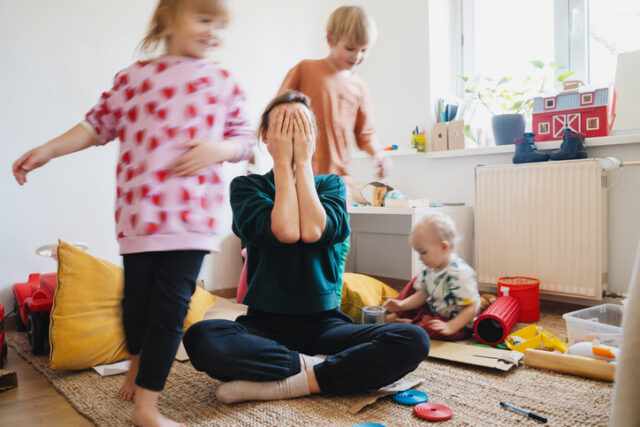
Beyond the headline satisfaction figures, research shows that mothers experience considerably more day-to-day emotional swings than people without children. The highs are higher and the lows are lower, which sounds manageable in theory but in practice means a sustained level of emotional intensity that takes a real toll over time. That volatility is one of the main reasons mothers report lower average wellbeing, even when they also describe their lives as meaningful and worthwhile.
Anxiety levels are also consistently higher among parents than among child-free adults, and this applies across different countries and demographic groups. The particular combination of disrupted sleep, financial pressure, frequent illness passed between small children and their parents, and the sheer relentlessness of childcare all contribute to a mental load that builds up gradually and is hard to fully step back from. Knowing this going in doesn’t necessarily change the decision, but it does change how prepared people feel for what’s actually ahead of them.
People are notoriously bad at predicting what will make them happy long term.
One of the more uncomfortable findings in happiness research is that humans consistently overestimate how happy future events will make them, and having children is no exception. Most people who want children expect parenthood to improve their lives significantly.
The research suggests the reality is that most people adapt to having children rather than becoming noticeably happier as a result. The experience is different from what they imagined, the adjustment is harder, and the daily texture of life with small children is far less romantic than the version most people picture beforehand.
This isn’t unique to parenthood. People tend to overestimate the happiness boost from most major life events, including marriage, promotions, and moving somewhere new. But parenthood is unusual because the decision is irreversible in a way that most others aren’t, which gives the expectation gap a different kind of weight. The research isn’t suggesting people shouldn’t have children. It’s pointing out that going in with a more realistic picture of what to expect would leave fewer people feeling blindsided.
Children add meaning to life, even when they reduce day-to-day happiness.
The distinction between happiness and meaning is one of the most important things the research on parenthood brings up, and it doesn’t get talked about enough. Parents consistently report that their lives feel more meaningful and purposeful than those of child-free people, even when they also report lower overall satisfaction. These are different things. Satisfaction is about how your life feels on an average Tuesday. Meaning is about whether you feel your life has a point. Parenthood tends to deliver more of the second while taking a toll on the first.
Many parents say this trade-off feels entirely worth it. They’re not describing every day as joyful, but they are describing a sense that their life has direction and importance that they value deeply. The research supports this fairly consistently across different countries and socioeconomic groups, regardless of education level or age. The question of whether the meaning is worth the cost is one only individuals can answer for themselves, but at least knowing the trade-off exists means the decision is being made with clearer eyes.
Where you live has a huge effect on how parenthood feels.
Not all countries produce the same findings when it comes to parenthood and wellbeing, and the differences are striking. In the Nordic countries, parents report both higher life satisfaction and a greater sense of meaning than their child-free peers, which flips the pattern seen in most other places. The most obvious explanation is that those countries make having children far easier and less financially punishing than the UK or the US do.
Generous parental leave, affordable high-quality childcare, and a cultural emphasis on supporting families all make the daily reality of parenthood less gruelling. That suggests the wellbeing hit that parents in other countries experience isn’t an inevitable feature of having children but a product of how much or how little support is available to them. If the conditions around parenthood improve, the experience of parenthood improves with them, which is a useful thing to keep in mind when the conversation turns to declining birth rates and what, if anything, governments should do about them.
Most parents don’t regret it, and many wish they’d had more children.

Despite everything the research shows about lower satisfaction and higher anxiety, the vast majority of parents don’t regret having children. UK polling found that only 8% of parents said they regretted it, with another 6% having felt that way at some point but no longer. It’s far more common for parents to say they wish they’d had more children than to wish they’d had fewer or none at all.
Life satisfaction figures also tell a more complicated story across a lifetime. Data from the Office for National Statistics shows that happiness and life satisfaction drop in the late 30s and 40s, which is typically when parenthood is most demanding. But by the 60s and 70s, people become much happier again, at an age that often corresponds with grandparenthood. It suggests that people who have children may be making a longer-term bet on their own happiness, one that looks like a poor deal in the middle years and pays off considerably later on.